Last Updated: January 15, 2026 | Editorial Review: BodyEase Lab (Biomechanics-verified) | Method: 35-day morning routine log + posture/sitting timing notes (educational case-style write-up)
Clinical Disclaimer: Educational biomechanics analysis — not a diagnosis. Seek urgent care for red flags like sudden weakness, numbness, saddle anesthesia, fever, unexplained weight loss, or bowel/bladder changes.
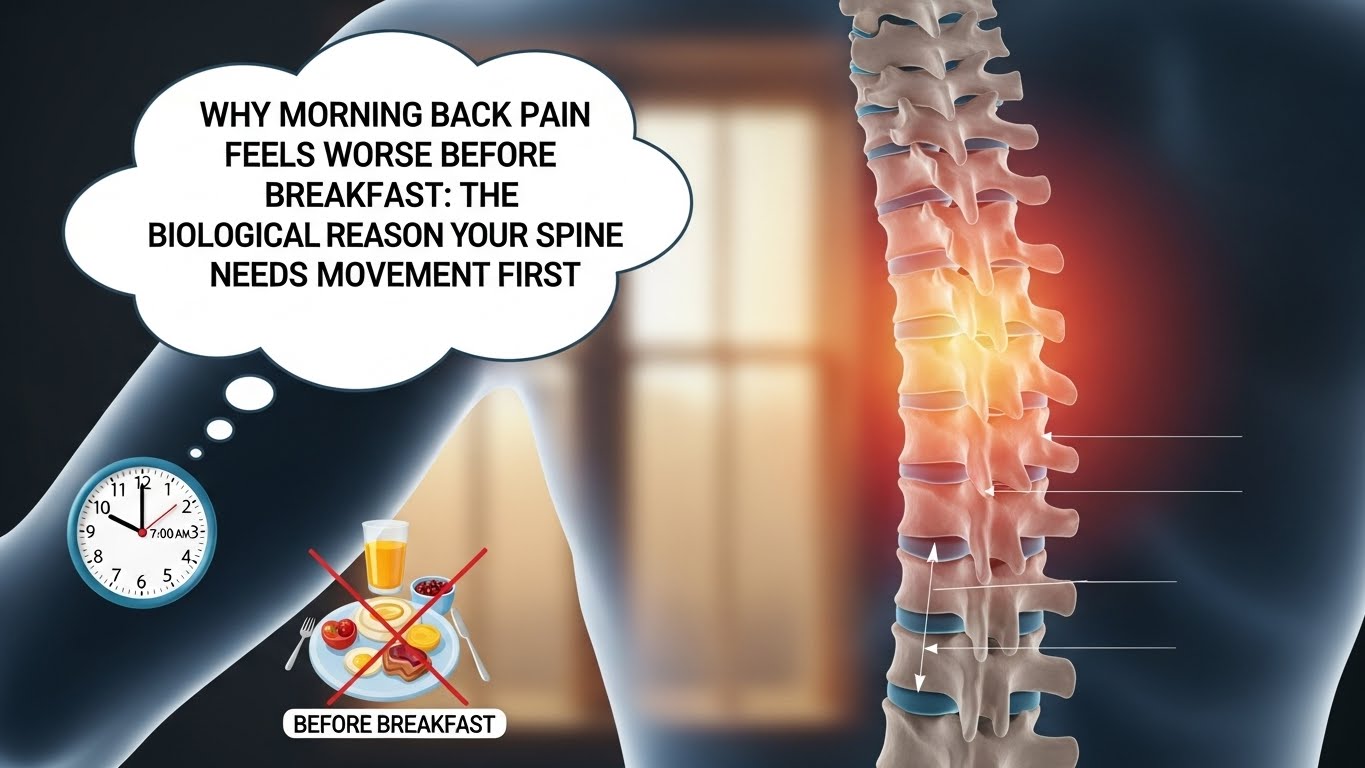
QUICK ANSWER Before breakfast is a “pressure + stiffness” window.
Many people feel worse before eating because the real trigger isn’t food — it’s timing. After a night lying down, spinal discs and soft tissues tend to be more “full” and sensitive. If you go bed → chair → forward-lean (table posture) too fast, you load a system that hasn’t been “primed” yet.
What’s peakingDisc sensitivity + joint “gel” + guarding
Worst comboImmediate sitting + forward reach
Best leverMove first (low-force, rhythmic)
You wake up late, shuffle to the kitchen, and the moment you sit down for coffee your back throws a tantrum. It feels stiff, guarded, almost brittle — like your spine is “not ready” for the day.
Here’s the counterintuitive part: on mornings like that, the fix usually isn’t a bigger stretch or a different breakfast. It’s the order of operations. Your spine often needs movement first, then sitting, then eating.
Personal-tip-you-can-test: if the breakfast chair aggravates you, eat standing at the counter for the first 3–5 minutes while you do gentle side-to-side weight shifts — then sit down once your back feels “warmer.”
Deep Dive: The 4 Biological Reasons You Wake Up “Locked”
Morning stiffness isn’t just “tight muscles.” It’s a daily cycle problem: fluids shift, tissues rehydrate, and your nervous system starts the day cautious.
1) Disc rehydration overnight (more sensitive in the morning)
When you lie down, spinal discs can rehydrate and slightly increase in height. That’s normal — but it can also mean your discs are a bit more pressurized/sensitive right after waking. Early heavy flexion (bending forward) and sudden sitting can feel harsher during this window.
2) Synovial “gel” effect (your joints feel rusty until you move)
Joint fluid behaves differently when you’ve been still for hours. The first few minutes of movement act like an engine warm-up — reducing friction and improving glide. That’s why gentle motion often beats aggressive stretching at 6 AM.
3) Overnight “pooling” + low circulation (you need a pump)
You’ve been in one position for hours. Circulation is calmer. Tissues can feel stiff and sticky. Rhythmic walking and light shifting create a gentle “pump” that improves blood flow and reduces that stuck feeling.
4) Nervous system guarding (your body starts protective)
In the morning, your nervous system can be extra protective. If your first move is abrupt (sit-up, twist, reach, rush), the brain may interpret it as threat and “brace” the trunk. Gentle repetition signals safety and reduces guarding.

Why “Before Breakfast” Triggers It (The Table Posture Trap)
If your pain spikes right when you sit down to eat, it’s often the posture stack: chair compression + slight forward hinge + reaching for a bowl/mug. That combo loads the spine during the exact window when tissues are least “ready.”
Quick self-check:
If your back feels worse when you sit + lean forward, but improves after walking, that pattern leans mechanical/guarding rather than “food inflammation.” (Persistent or progressive symptoms still deserve medical review.)
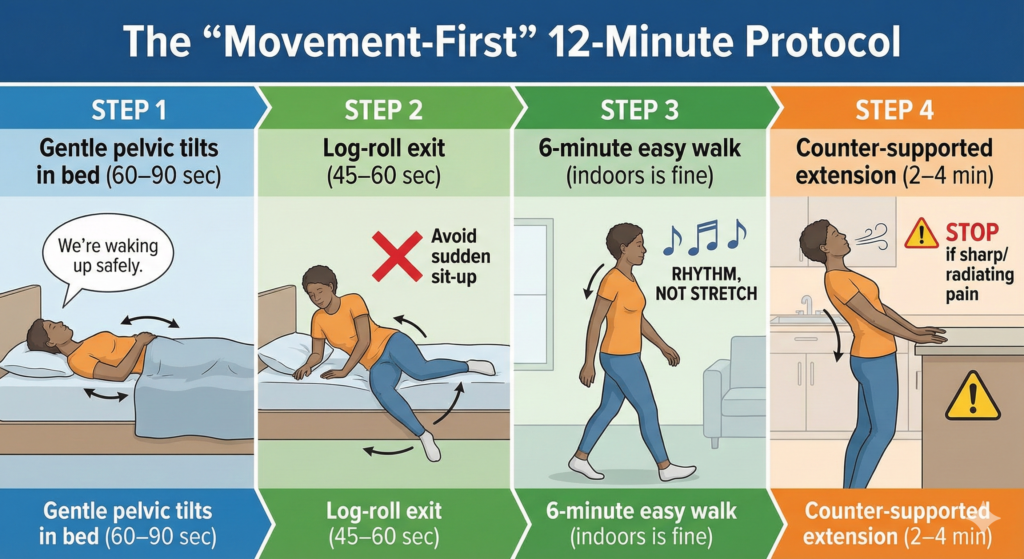
The “Movement-First” 12-Minute Protocol
This is not a workout. It’s a transition. The goal is to lower stiffness and guarding before you add sitting and forward-lean tasks (breakfast, shoes, laptop).
- Gentle pelvic tilts in bed (60–90 sec): small range, slow breath. You’re telling the system “we’re waking up safely.”
- Log-roll exit (45–60 sec): roll to your side, legs off the bed, push up with arms. Avoid a sudden sit-up if mornings are sensitive.
- 6-minute easy walk (indoors is fine): relaxed arms, shoulders down. Think “rhythm,” not “stretch.”
- Counter-supported extension (2–4 min): hands on counter, gentle lean back with long exhale. Stop if it causes sharp pain or radiating symptoms.
| Morning order | What it usually feels like | Why | Better alternative |
|---|---|---|---|
| Move → then eat | Looser, less guarded | You “prime” joints/tissues before sitting | Keep breakfast simple and upright |
| Eat (sit) → then move | Often stiff or “pinchy” | Early sitting + forward reach loads a sensitive window | Stand at counter briefly |
| Bed → stand fast → rush | Guarding spikes | Abrupt load + threat signal | Slow transition + rhythm |
Common Mistakes That Keep the Morning “Stuck”
- The “pain test” bend: bending forward immediately to “see if it’s better.” This often triggers guarding and makes you feel worse for the next 10 minutes.
- Cold stretching with force: long holds and deep toe touches before you’ve warmed up. Morning tissues typically prefer rhythm first.
- Instant chair time: sitting down for breakfast or scrolling with a rounded back before you’ve moved at all.
Pro Tip (small, high leverage):
If you must sit early, set the chair up so your hips are slightly higher than your knees (folded towel under you works), then keep your mug/bowl closer so you don’t reach and round forward repeatedly.

FAQ: Navigating the Morning “Danger Zone”
Is morning stiffness always a sign of damage?
Not necessarily. Many people experience a normal morning stiffness window that improves with gentle movement. The pattern that matters: does it ease with light walking and safer posture, or does it progressively worsen?
Can foods make it worse before breakfast?
Diet can influence inflammation overall, but the timing (pain before eating, improved after moving) often points to mechanics: early sitting, forward lean, and a body that hasn’t been primed yet.
The “60-Minute Rule” (when to take it more seriously)
If stiffness/pain persists beyond about an hour on most mornings, worsens over weeks, wakes you at night, or includes leg weakness/numbness, radiating pain below the knee, fever, or bowel/bladder changes — get evaluated.
Continue Your Recovery Journey
- The 5 Biological Reasons Your Back Hurts After Waking Up
- Back Feels Locked? The “Cold Honey” Mechanism Explained
- My Morning Protocol for Chronic Stiffness
Sources
1. Cleveland Clinic: Lower back pain in the morning
2. PubMed: Diurnal variation / morning changes related to spinal loading (disc-related research)
3. NCBI Bookshelf: Low back pain overview (educational reference)
Professional Disclaimer: Educational information only. Not a medical diagnosis or treatment plan. If symptoms are severe, persistent, or worsening — or if red flags appear — seek professional medical care.
Update Log:
– Jan 15, 2026: Final editorial pass for clarity and safety; strengthened “movement-first” explanation; added mistakes, pro tips, and a cleaner source list.

Hi, I’m Chris
I’m not a doctor or a physio. I’m just a guy who spent 5 years battling crippling morning back pain while sitting at a desk job.
Traditional advice didn’t work for me, so I became obsessed with researching the science of recovery. This blog contains the practical, tested routines that finally helped me wake up pain-free.