Last Updated: January 12, 2026 | Editorial Review: BodyEase Lab (Evidence-checked) | Note: Informational only (not medical advice)
Disclaimer: This article is for educational purposes only. It does not diagnose, treat, or replace professional medical care. If stiffness or pain is persistent, consult a licensed professional.
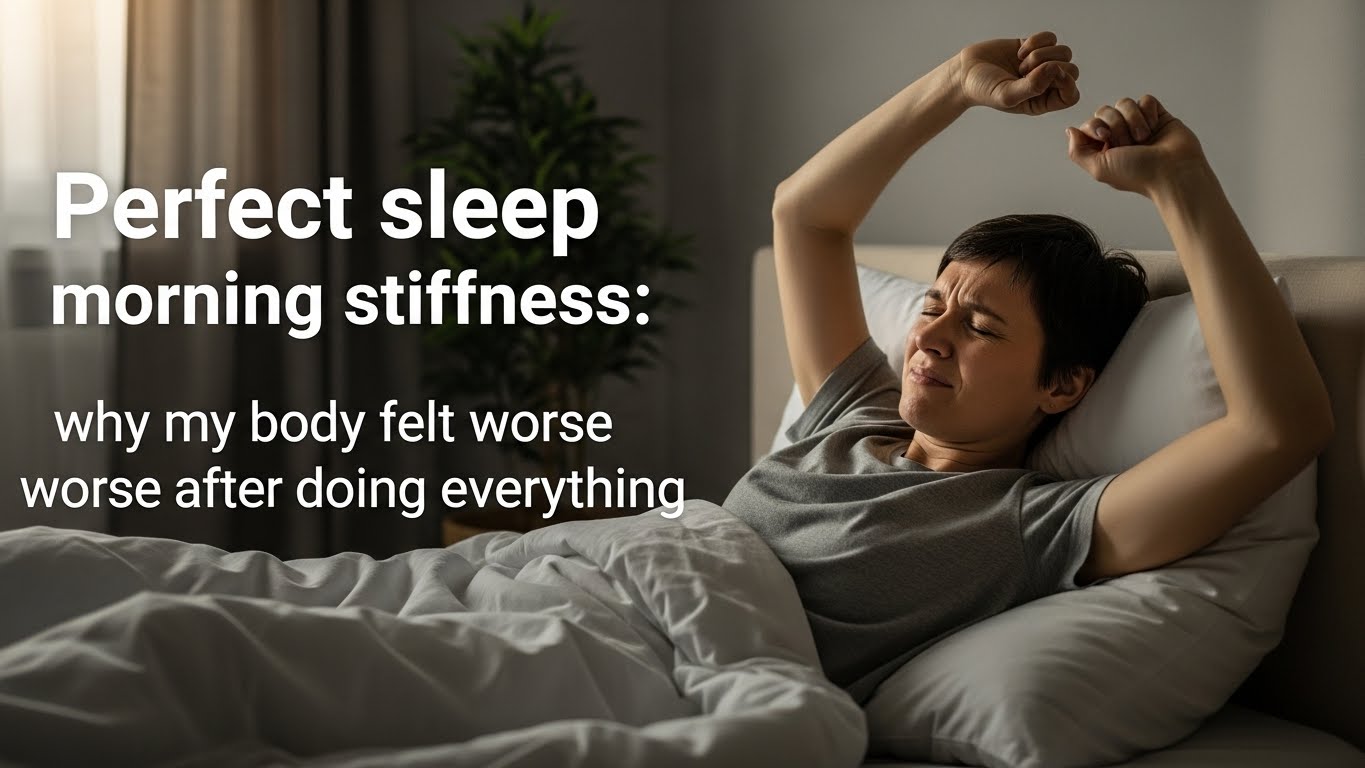
“Perfect” sleep… and you wake up stiff? You’re not broken. You’re just cold-starting.
I used to take it personally. Like my body was betraying me. If I nailed the room temp, hit 8 hours, avoided screens, and still woke up like a rusty hinge… what was the point?
Here’s the simple truth: “perfect” sleep often means long, quiet stillness. And stillness has a price. Your joints and soft tissues can feel “gelled up,” compressed, and slow to wake. It’s less about sleep discipline and more about what your body was doing (or not doing) for 6–9 hours.
- The “Morning Gel” feel: After hours of minimal movement, joints can feel thick and sticky until you start moving.
- The immobility paradox: Deep sleep = fewer position changes = more time loading the same tissues.
- The 10–30 minute clue: If gentle movement melts stiffness within ~30 minutes, that’s usually a normal warm-up pattern.
Quick safety check
- Stiffness that lasts > 60 minutes most mornings
- Visible swelling, warmth, redness, or a “puffy” joint feeling
- Fever, unexplained fatigue, or symptoms that are getting worse week by week
If any of those sound like you, don’t self-diagnose from a blog post. Get a professional opinion.
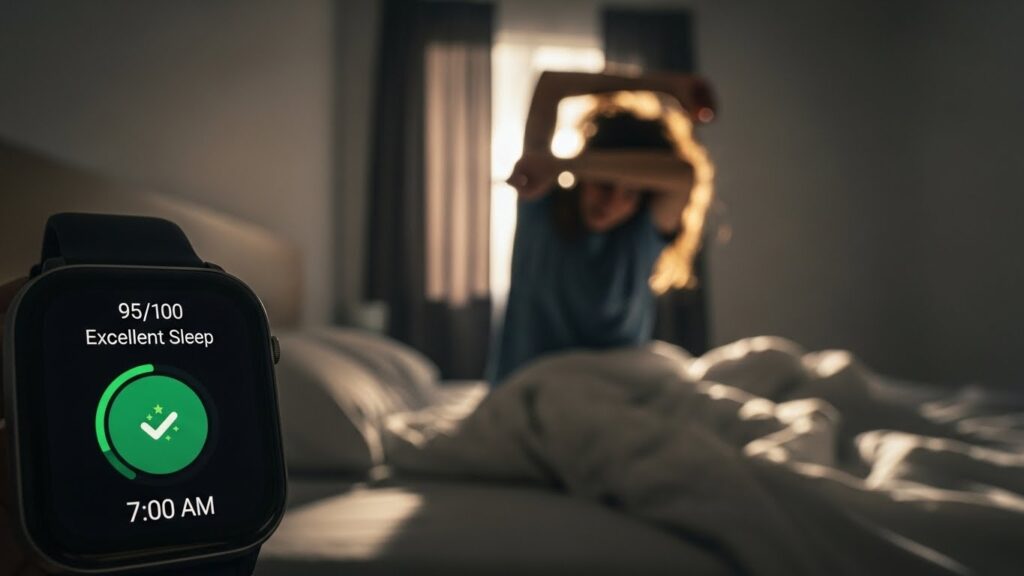
I used to obsess over the phrase perfect sleep morning stiffness. I was a gold-star student of “sleep hygiene”: cool room, blackout curtains, consistent schedule. My tracker loved me.
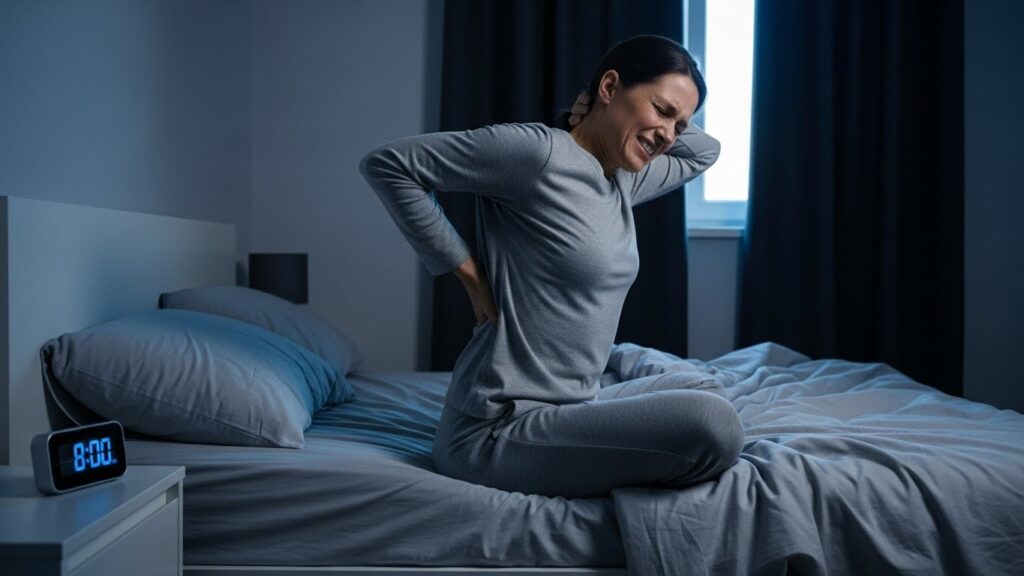
But the mornings? Not so much. Some days I’d swing my legs out of bed and feel that first “uh-oh” tug in my lower back. You know the feeling—like someone quietly replaced your spine with a stiff board overnight.
That’s when the mindset flipped: I stopped trying to perfect the night and started mastering the transition out of it. Because the real problem wasn’t “bad sleep.” It was a rough wake-up ramp.
💡 The “Cold Engine” summary (in plain English)
Think of your body like a car on a cold morning. Even if the engine is “perfect,” it won’t run smooth the second you turn the key. Perfect sleep morning stiffness is often your body’s “idle time”: joints warming up, tissues rehydrating, and muscles letting go after long stillness.
The paradox of “doing everything right”
Most sleep advice is about the room: darkness, temperature, screens, bedtime. All useful. But your body has another scoreboard—one your tracker can’t see: static loading (how long your tissues stayed in one position).
1) The “Morning Gel” effect: your joints don’t love being parked
During the day, movement acts like a gentle pump. It helps joints feel “oiled” and ready. Overnight, especially during deep sleep, that pumping slows way down. So when you wake, the first few bends and twists can feel… thick.
People describe it like being the Tin Man. Or like the hinges are tight. That description isn’t dramatic—it’s actually pretty accurate to how it feels.
2) The deep-sleep trap: fewer position changes can mean more pressure
We tend to label “not moving” as great sleep. But if your back or hips are sensitive, staying in one angle for 7–9 hours can be an endurance event. The same spots take the load. The same muscles hold the line. All night.
Ever wake up and feel that one-sided tightness—one hip cranky, one side of your back annoyed? That’s often your body reporting, “Hey… we marinated in that position too long.”
3) Why your tracker is lying to you (kind of)
A wearable can estimate sleep stages. It can’t measure “morning function.” It won’t capture the small stuff: the stiff neck when you turn to look at your phone, the first-step discomfort, the slow-to-stand feeling.
So yes—your sleep can be “perfect” on the app and still feel rough in the first 15 minutes. Both can be true.
Key insight: Stiffness after rest is often a normal feature—not a bug. It becomes a red flag when it’s intense, doesn’t ease with movement, or comes with swelling or systemic symptoms.
What I noticed on my “perfect sleep” nights
- The “Statue” effect: The better I slept, the less I moved—and the more “locked” my lower back felt at 7 AM.
- The cold-start lag: On extra cool nights, I’d need a few more minutes before my body felt normal.
- The frustration loop: Expecting 100% made a totally normal 70% feel like failure.
Common mistake (I made this for months)
- Chasing a higher sleep score instead of chasing a smoother morning.
- Blaming the mattress when the real issue was static loading + a zero-warm-up morning routine.
- Testing changes with only one morning (your body has noisy days—look for patterns across a week).
How I reframed “perfect sleep” for my back
I didn’t throw away my blackout curtains. I just changed what “success” meant. Instead of demanding to wake up brand new, I built a 5-minute morning transition. That’s the part most people skip.
Pro-Tip: the “two-position rule” before standing
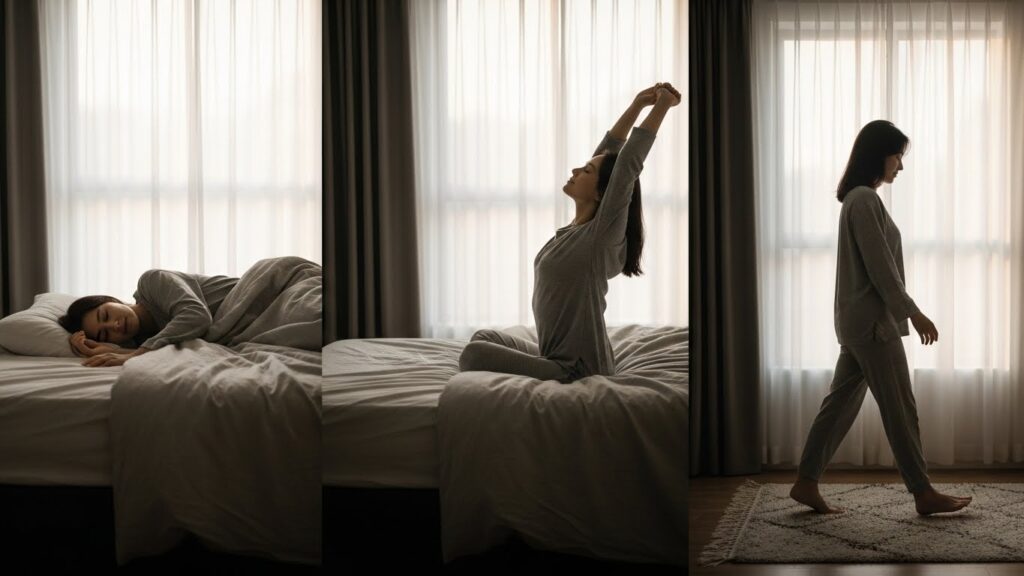
Before your feet hit the floor, change your position twice. That’s it. It’s a mini reset that reduces the “all-at-once” load on your spine. Roll to your side, pause for 5–10 seconds, then sit up slowly. You’re telling your tissues, “We’re waking up now—no surprises.”
A simple 5-minute “reboot” (no equipment)
We’re not doing a workout. We’re just turning the lights on for your joints and muscles. You can do this in pajamas. Half-awake. That’s the point.
- Minute 1 (in bed): 5 slow ankle pumps + 3 gentle knee bends per side.
- Minute 2 (in bed): One easy “knee-to-chest” hug per side (no yanking).
- Minute 3 (side-lying): Roll to your side, breathe for 3 slow breaths, then push up with your arms.
- Minute 4 (edge of bed): Sit tall, do 3 small shoulder rolls, then 3 gentle trunk turns (tiny range).
- Minute 5 (standing): Slow walk to the bathroom/kitchen. Just moving counts.
The first time I did this consistently, I noticed something funny: I didn’t need “perfect” sleep anymore. I needed a perfect exit.
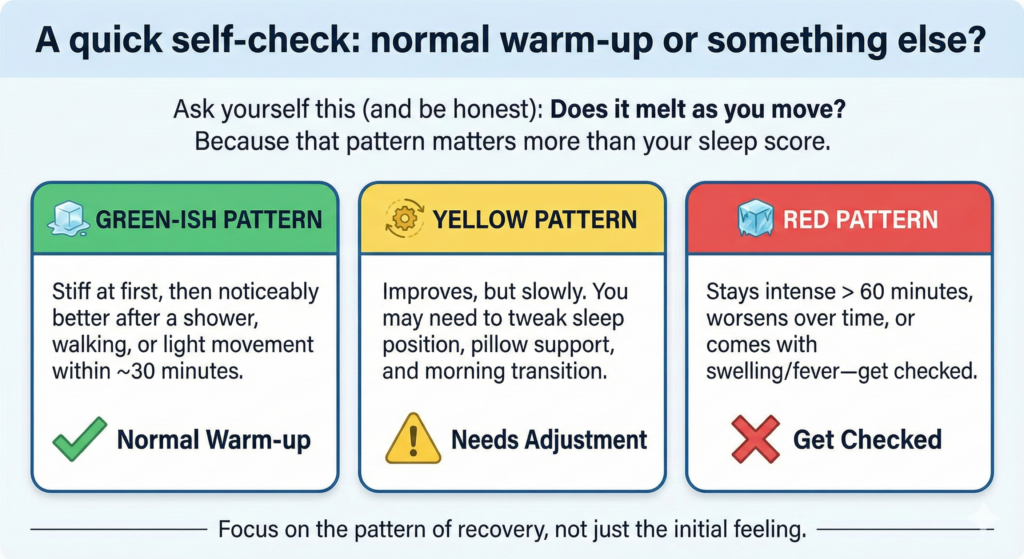
A quick self-check: normal warm-up or something else?
Ask yourself this (and be honest): Does it melt as you move? Because that pattern matters more than your sleep score.
- Green-ish pattern: Stiff at first, then noticeably better after a shower, walking, or light movement within ~30 minutes.
- Yellow pattern: Improves, but slowly. You may need to tweak sleep position, pillow support, and morning transition.
- Red pattern: Stays intense > 60 minutes, worsens over time, or comes with swelling/fever—get checked.
FAQ
Is morning stiffness inevitable as we age?
Some stiffness becomes more common with age, yes. But “normal” stiffness tends to improve with movement. If it’s persistent, severe, or paired with swelling, don’t write it off as “just aging.”
Should I set an alarm to move during the night?
No. Breaking sleep on purpose usually backfires. If you want less morning stiffness, focus on (1) a supportive sleep position and (2) a smoother morning transition.
When should I worry about “perfect sleep” stiffness?
If stiffness lasts longer than 60 minutes most mornings, if joints swell, or if you have systemic symptoms (fever, unusual fatigue), it’s worth getting evaluated.
Internal Links
Body Feels Better After Naps
Changed Sleep Position for a Week
Back Hurts After Waking Up
Sources (checked)
Sleep Foundation: How sleep works
Cleveland Clinic: Morning Gel & Joint Stiffness
E3 Chiropractic: Sleep immobility
Professional Disclaimer: While a “warm-up” phase is common after rest, persistent or severe pain isn’t “normal.” This article is for informational purposes and should not replace medical diagnosis. Always consult a healthcare professional for specific concerns.
Update Log:
– Jan 12, 2026: Rewritten for clearer intent match, improved “morning transition” protocol, and added Pro-Tip/Common Mistake sections.

Hi, I’m Chris
I’m not a doctor or a physio. I’m just a guy who spent 5 years battling crippling morning back pain while sitting at a desk job.
Traditional advice didn’t work for me, so I became obsessed with researching the science of recovery. This blog contains the practical, tested routines that finally helped me wake up pain-free.