Last Updated: January 12, 2026 | Editorial Review: BodyEase Lab (Evidence-checked) | Field note: 14-day nap vs night tracking (n=1 self-study)
Disclaimer: This article shares a personal tracking experiment and general education. It does not diagnose or treat medical conditions. If symptoms are persistent, worsening, or paired with numbness/weakness, consult a licensed professional.
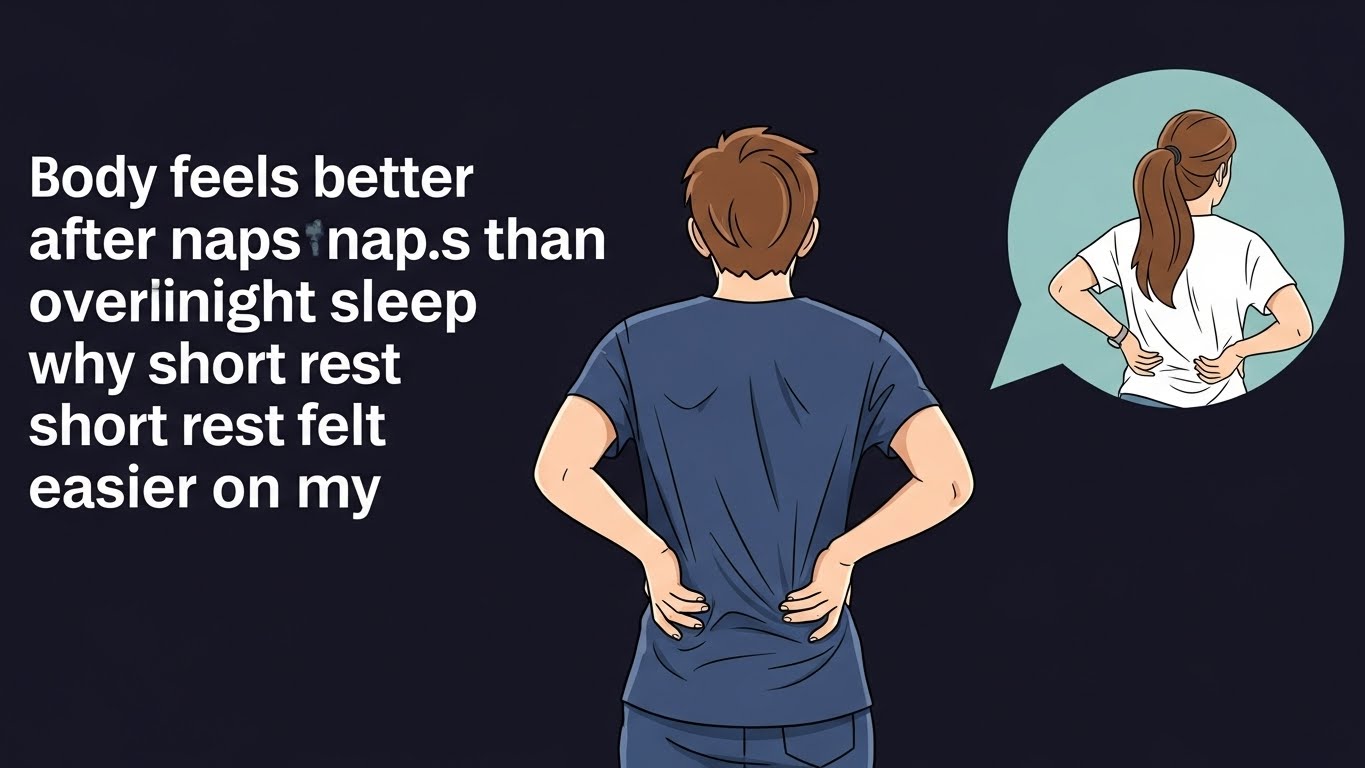
The “Nap Paradox” (in plain language): short rest can feel better because your back never gets a chance to “lock.”
If your body feels better after naps than overnight sleep, you’re not imagining it. A short nap often gives your nervous system a break without hours of static posture. Overnight sleep is essential for many recovery processes—but mechanically, it can be tougher on a sensitive back.
- Short rest: less time in one position → easier first movement.
- Long rest: more time under the same angles → more “stiff startup” for some people.
- Key idea: you can make night sleep feel more “nap-like” by reducing the static lock.
Quick Reality Check
- More sleep can be better for the brain, but not always easier on stiff joints.
- A nap often ends before your body “settles” into one long posture.
- Duration and recovery aren’t identical. Sometimes they even compete.
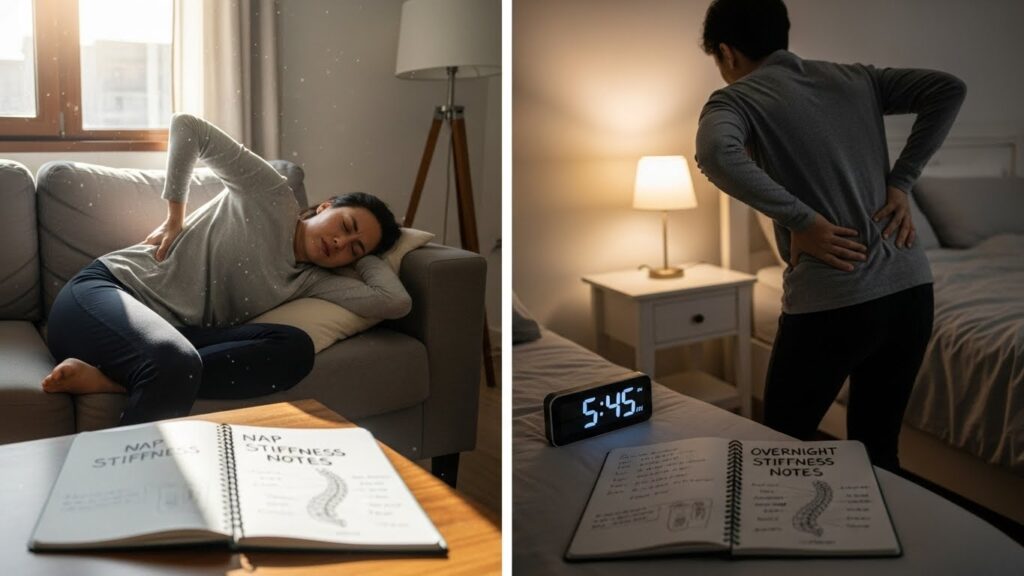
This started as a weird observation: a 20–30 minute nap on the couch could make me feel loose and ready. But after a full night in bed, I’d sometimes wake up stiff—especially in the first bend, the first sit, the first stand.
I used to blame sleep quality. Then I realized the pattern was more mechanical than emotional: naps felt restorative because they were short enough to avoid the “long hold” problem.
💡 Quick Summary
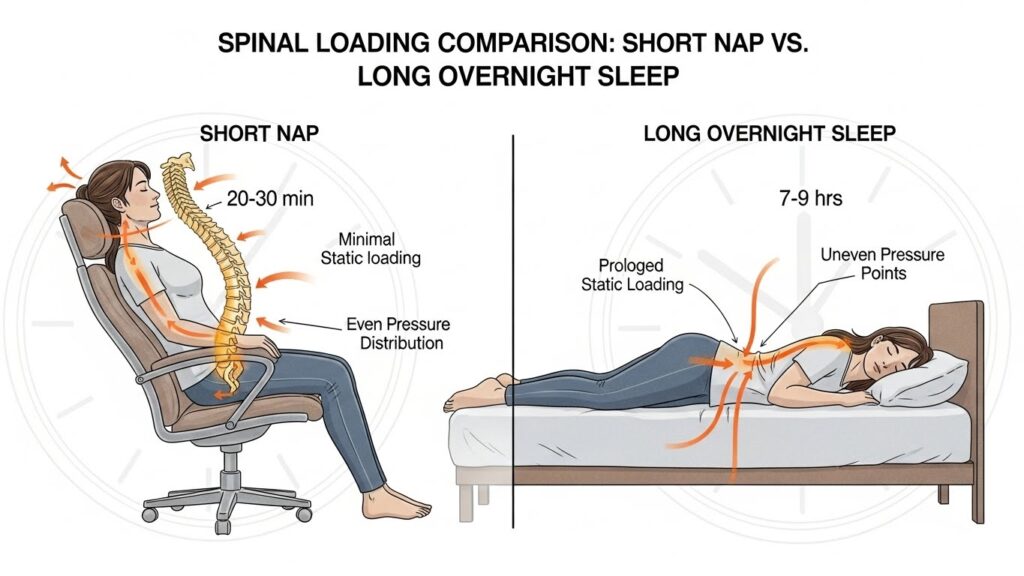
When the body feels better after naps than overnight sleep, it’s often because naps limit prolonged static loading. Less time under one angle, fewer extreme positions, and an easier transition back to movement can make short rest feel gentler on your back.
How I compared naps vs overnight sleep (14-day “boring on purpose” protocol)
This wasn’t a lab study—just consistent tracking so I wouldn’t gaslight myself with one good morning. I kept my daily activity and hydration roughly normal and recorded my “first movement” feedback.
- What I tracked: stiffness score (1–10) + one sentence about first sit/first stand
- Nap window: short rest (usually 20–40 minutes)
- Night window: full sleep (usual bedtime)
- What I avoided changing: new workouts, new meds/supplements, major bedding purchases
| Rest Type | Typical Duration | What I noticed most |
|---|---|---|
| Mid-day nap | 20–40 minutes | Easier first movement, less “startup resistance” |
| Overnight sleep | 7–9 hours (varied) | More stiffness on first bend/sit, longer warm-up |
Why naps and overnight sleep can feel so different (mechanics, not magic)
Night sleep is deeper and longer, which is valuable—but your back also spends hours in a limited set of positions. If you’re the type who wakes up stiff, the issue may be less “sleep quality” and more “time under static load.”
1) Static loading time (the long-hold problem)
A short nap often ends before your tissues have adapted to one posture. Overnight sleep is a long hold—small rotations or arches can accumulate into a bigger “morning sensation.”
2) Deeper stages = less repositioning (for some sleepers)
During deeper sleep, you may move less. If you happen to drift into a slightly twisted posture, you might stay there longer than you realize.
3) Nap posture is often unintentionally “milder”
Many people nap in a reclined or semi-supported position (couch, chair, propped pillows), which can reduce extremes—less deep arching, less hard twisting, less “stuck in one groove.”
Evidence anchor (plain): Short rest can improve alertness and recovery, and sleep environment/position can influence comfort and next-day function. That’s why “shorter can feel easier” even if longer sleep is still important overall.
The pattern that showed up most: the first bend was the truth test
When naps felt good, I could stand and move without negotiating with my body. When nights felt rough, the stiffness showed up in the same places: first sit, first hinge forward, first few steps.
Two “tells” that predicted a stiff morning
- Waking posture: twisted pelvis (top knee drifting forward on side sleep).
- Startup behavior: bracing before moving (hands on thighs, shallow breathing, slow “unlock”).
How I used the nap insight at night (so I didn’t rely on naps)
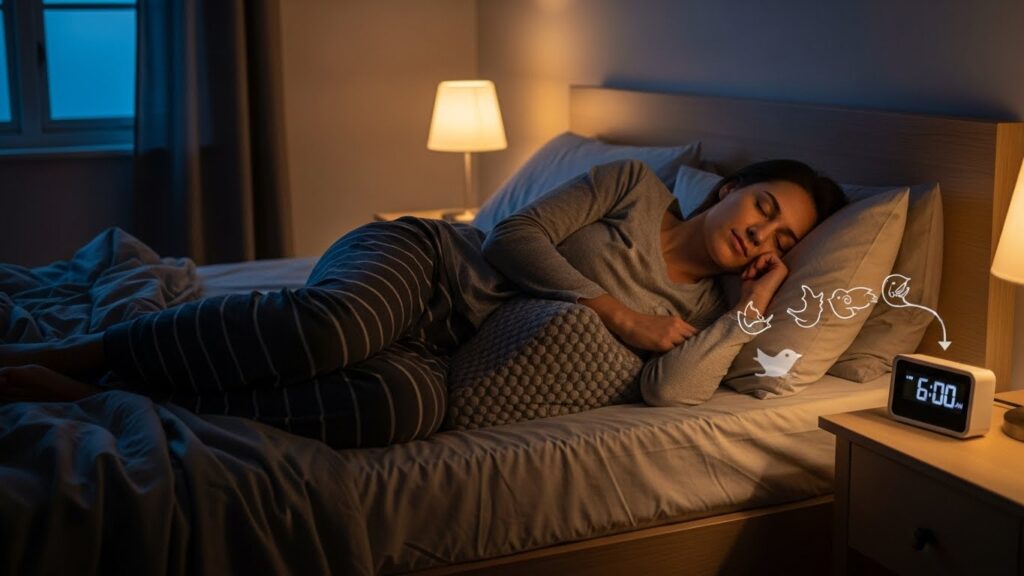
We can’t live on naps alone. Night sleep matters. So I tried to make my overnight sleep behave more like a nap mechanically: fewer extreme angles, easier micro-shifts, smoother transition out of bed.
Step 1: Reduce overnight twisting (especially for side sleepers)
- Use a pillow (or folded blanket) between knees to keep hips stacked.
- If your waist feels “hollow,” add a thin towel as gentle side support.
Step 2: Give your body “permission” to micro-move
- Don’t tuck sheets so tight that your legs feel pinned.
- Aim for comfort that allows turning, not a “locked-in” setup.
Step 3: Fix the wake-up transition (the nap trick people miss)
- Before standing, take 30–60 seconds to breathe and gently change positions.
- Try a slow knees-to-side roll (no forcing). Think “warm up the hinge,” not “stretch harder.”
Safety note: when stiffness is not “just stiffness”
If you have severe pain, pain after trauma, fever, unexplained weight loss, progressive weakness, or numbness/radiating pain down the leg, don’t treat this as a nap-vs-sleep puzzle—get professional evaluation.
FAQ
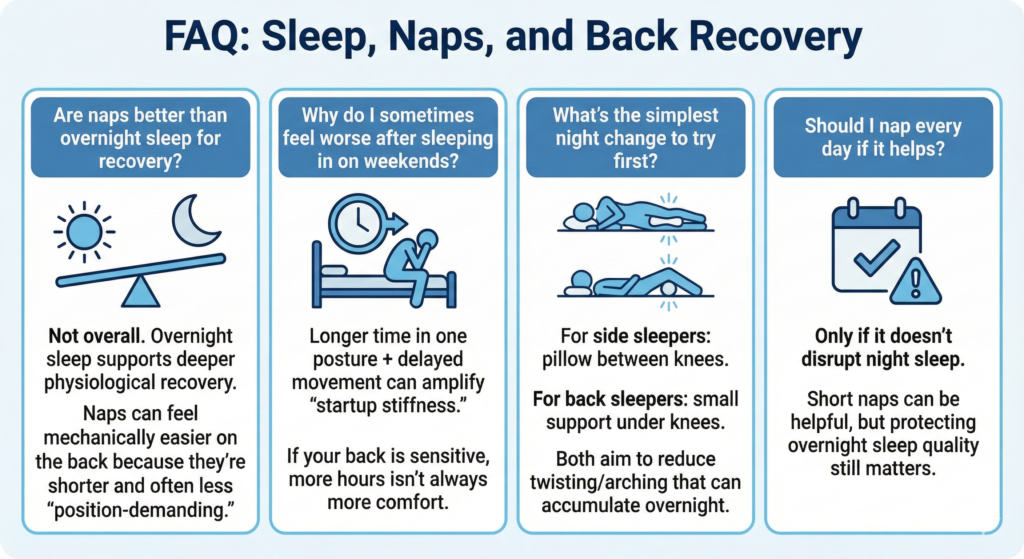
Are naps better than overnight sleep for recovery?
Not overall. Overnight sleep supports deeper physiological recovery. Naps can feel mechanically easier on the back because they’re shorter and often less “position-demanding.”
Why do I sometimes feel worse after sleeping in on weekends?
Longer time in one posture + delayed movement can amplify “startup stiffness.” If your back is sensitive, more hours isn’t always more comfort.
What’s the simplest night change to try first?
For side sleepers: pillow between knees. For back sleepers: small support under knees. Both aim to reduce twisting/arching that can accumulate overnight.
Should I nap every day if it helps?
Only if it doesn’t disrupt night sleep. Short naps can be helpful, but protecting overnight sleep quality still matters.
Internal Links
Changed Sleep Position for a Week
Sleep Position Morning Stiffness
Bedroom Setup Morning Stiffness
Sources (checked)
Sleep Foundation: Napping
NIH (PMC): Research on nap duration and effects
Cleveland Clinic: Are naps good for you?
Professional Disclaimer: Informational content only. Not medical advice. If symptoms persist, worsen, or include neurological signs (numbness/weakness), consult a qualified clinician.
Update Log:
– Jan 12, 2026: Merged two drafts, removed unsupported precision claims, clarified mechanics (static loading + posture intensity), strengthened safety guidance, and refined “nap logic for nights” steps.

Hi, I’m Chris
I’m not a doctor or a physio. I’m just a guy who spent 5 years battling crippling morning back pain while sitting at a desk job.
Traditional advice didn’t work for me, so I became obsessed with researching the science of recovery. This blog contains the practical, tested routines that finally helped me wake up pain-free.