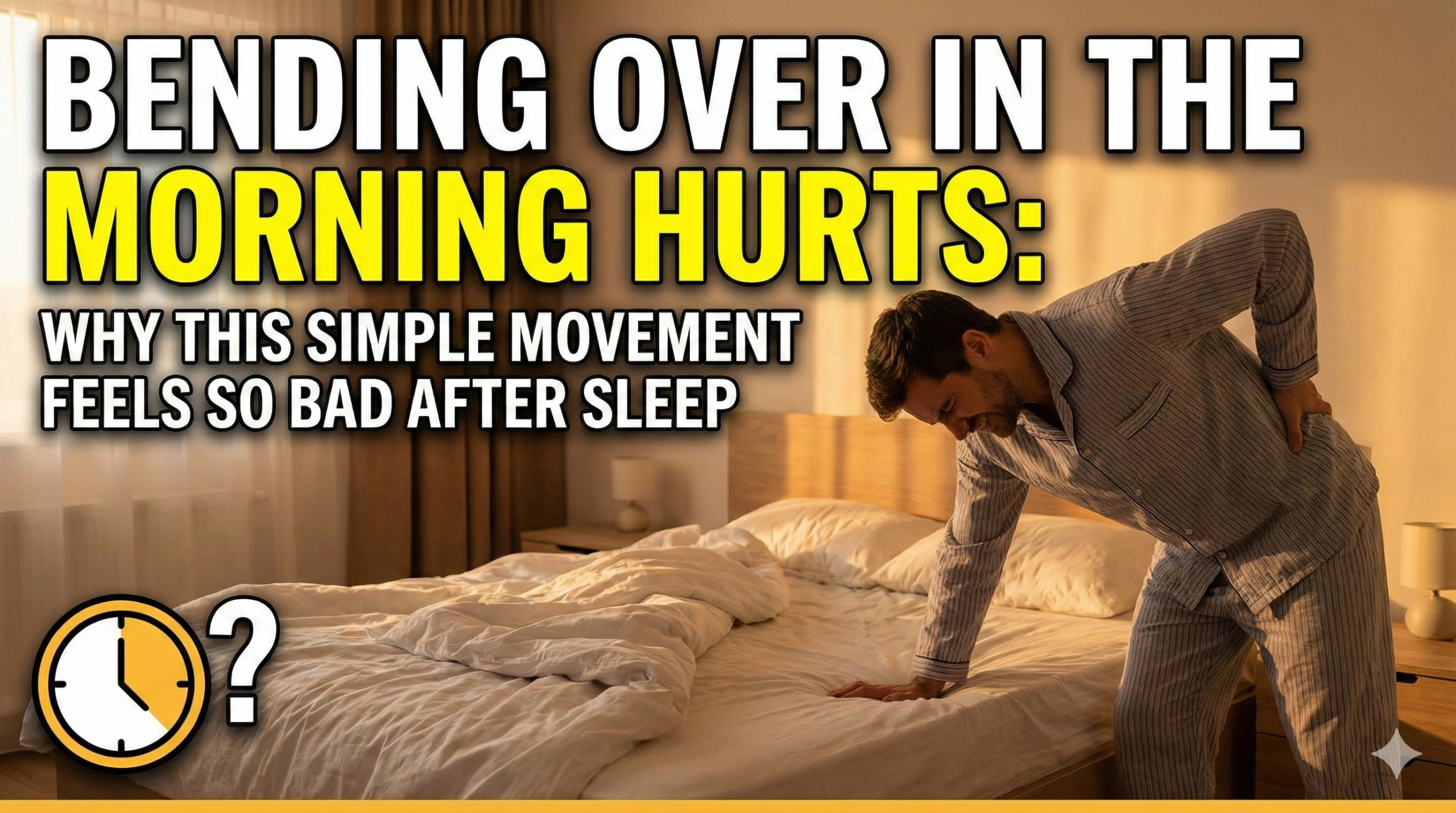
Why does bending over in the morning hurt so much?
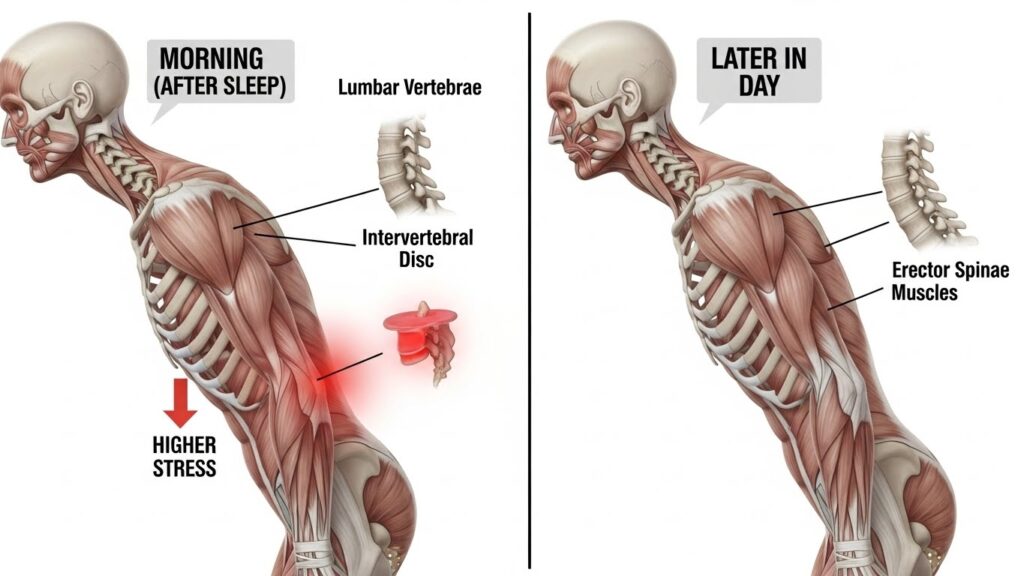
When bending over in the morning hurts, it’s often because your spinal discs are at their daily peak “fullness” after sleep. Overnight, discs rehydrate (imbibition), which increases intradiscal pressure and makes the outer ring (annulus fibrosus) less tolerant to deep forward flexion— especially during the first 30–60 minutes after getting up.
- The 30-Minute Rule: delay deep forward bends right after waking.
- Hip Hinge: bend at hips + knees, keep spine neutral (no “rounding”).
- Micro-Decompression: walk 3–5 minutes before the first “real” bend.
- No pain testing: repeating the bend “to check” often backfires.
⚠️ Red Flags (don’t ignore these)
- Sudden leg weakness, major loss of coordination, or repeated falling.
- Numbness in the “saddle area” (groin / inner thighs).
- Loss of bladder or bowel control (urgent evaluation).
- Severe radiating pain that prevents standing or walking normally.
Last Updated: December 28, 2025 | Editorial Review: BodyEase Lab (Evidence-checked) | Note: Informational only (not medical advice)
💡 Quick Summary (read this first)
If bending over in the morning hurts, it usually isn’t random. Early morning is a sensitive window: discs are more hydrated, tissues are stiffer, and the first deep bend combines flexion + load + muscle lengthening all at once. Many people feel noticeably better by (1) walking 3–5 minutes, (2) using a hip hinge for the first pickups, and (3) avoiding repeated “pain checks.”
bending over in the morning hurts was the exact phrase I typed into Google after noticing a weird pattern: lying down felt fine, walking felt okay, but the moment I bent forward—usually for socks or something on the floor— it felt sharp and unforgiving.
The helpful shift was realizing it’s not just “stiffness.” It’s a predictable mechanical setup after sleep. Once you understand why the first bend spikes, your mornings stop feeling like a gamble.
Table of Contents
- 1) Why morning bending can feel sharply worse
- 2) The mechanics: discs + connective tissue after sleep
- 3) Patterns that quietly make it worse
- 4) The 30-minute transition plan
- 5) How to bend safely (hip hinge + “first bend” rules)
- 6) FAQ
- 7) Internal Links
- 8) Sources
- 9) Professional Disclaimer
1) Why morning bending can feel sharply worse
Forward bending (flexion) is one of those movements that can feel totally normal at noon—yet sting at 8 a.m. The reason is timing: your body wakes up in a different “mechanical state” than it lives in during the day.
- Flexion loads the spine early: socks, shoes, picking things up—these are bending + load together.
- Tissues are less compliant: after hours of stillness, ligaments/fascia behave stiffer (viscoelasticity).
- We often test it: repeating the bend “to see if it still hurts” can keep irritation going.
2) The mechanics: discs + connective tissue after sleep
2-1) Nocturnal rehydration (imbibition) and peak intradiscal pressure
Spinal discs behave like sponges. During sleep, unloading lets them absorb fluid and regain height. That’s normal—and healthy. The tradeoff is that right after waking, discs can be at their daily peak in intradiscal pressure. Deep forward bending when the disc is “full” can irritate the outer ring (annulus fibrosus) more easily.
2-2) Viscoelastic stiffness: why tissues feel “tight” before they’ve moved
Ligaments and fascia are viscoelastic: they become more compliant with movement and heat. Early in the day, before you’ve walked or changed positions much, the system is simply less ready to tolerate a deep bend—especially a fast one.
Quick standard (morning bending rule)
- If bending over in the morning hurts, don’t “check it” repeatedly.
- The first deep forward bend is often the most stressful.
- Delay bending until you’ve moved for a few minutes.
3) Patterns that quietly made it worse
Once I stopped treating it like random pain, three patterns jumped out:
- The Sock Test: bending immediately at the bed edge to put socks on.
- The Pain Check Loop: bending again to see if it’s gone (often worse).
- The Rushed Morning: weekdays felt worse than weekends because I forced the first bend earlier.

4) The 30-minute transition plan (simple, not dramatic)
This isn’t a “perfect posture” routine. It’s a timing routine. The goal is to let gravity and gentle movement reduce that early sensitivity before you ask your back to do a deep bend.
| Instead of | Try this | Why it helps |
|---|---|---|
| Deep bend immediately | Walk 3–5 minutes | Gentle decompression + tissue “wake-up” |
| Bend from the waist | Hip hinge (hips + knees) | Reduces flexion stress on the disc ring |
| Pain-testing bends | One check later (after movement) | Less irritation stacking |

5) How to bend safely (hip hinge + “first bend” rules)
5-1) The hip hinge cue (one sentence)
Push hips back, soften knees, keep the spine “long,” and let the movement come from hips—not the low back rounding.
5-2) The “first bend” rules (practical)
- Use height: bring the task up (chair/bed height) instead of going to the floor first.
- Slow beats deep: the first bend should be shallow and controlled, not a full toe-touch.
- Split the task: socks/shoes: sit down, one leg at a time, no rushing.
- If it spikes: step back—walk 60 seconds, reset, then try again later (not repeatedly).
Small but underrated fix:
If mornings are always worse, set up your environment the night before: keep socks/shoes at chair height, avoid picking items off the floor right after waking, and remove the “rush-bend” from your first 10 minutes.
6) FAQ
Is it bad to bend in the morning?
Not inherently. It’s often about timing and intensity. Many people tolerate bending better after a few minutes of movement.
Should I do toe-touches to “loosen up”?
If bending over in the morning hurts, deep flexion stretching right away can be provocative for some people. Gentle walking and controlled movement usually make more sense than forcing a deep stretch.
Why does it fade by noon?
As you move through the day, discs and soft tissues adapt and become more tolerant to flexion and load.
What if pain shoots down the leg?
Radiating symptoms, numbness, weakness, or major functional changes should be evaluated by a licensed professional—especially with red flags.
Internal Links
Back Hurts After Waking Up: Why Pain Peaks Right After Getting Out of Bed
Morning Back Pain Routine: My 10-Minute Stiffness Protocol
Stretching Right After Waking Up: The Truth About “Loosening Up”
Sources (checked)
PubMed: Diurnal variation in spinal mechanics and its clinical significance
Cleveland Clinic: Managing morning back stiffness and pain
Sleep Foundation: Waking up with lower back pain
Professional Disclaimer: This content is for educational purposes only and does not diagnose, treat, or replace professional medical care. If symptoms are severe, worsening, persistent, or include neurological changes, seek licensed medical evaluation.
Update Log:
– Jan 01, 2026: Combined disc rehydration explanation + behavior patterns + 30-minute transition plan; converted external sources to one-line format.

Hi, I’m Chris
I’m not a doctor or a physio. I’m just a guy who spent 5 years battling crippling morning back pain while sitting at a desk job.
Traditional advice didn’t work for me, so I became obsessed with researching the science of recovery. This blog contains the practical, tested routines that finally helped me wake up pain-free.