
Does a simple morning sneeze feel like a lightning strike in your lower back? It’s usually a pressure spike hitting a stiff, bent spine.
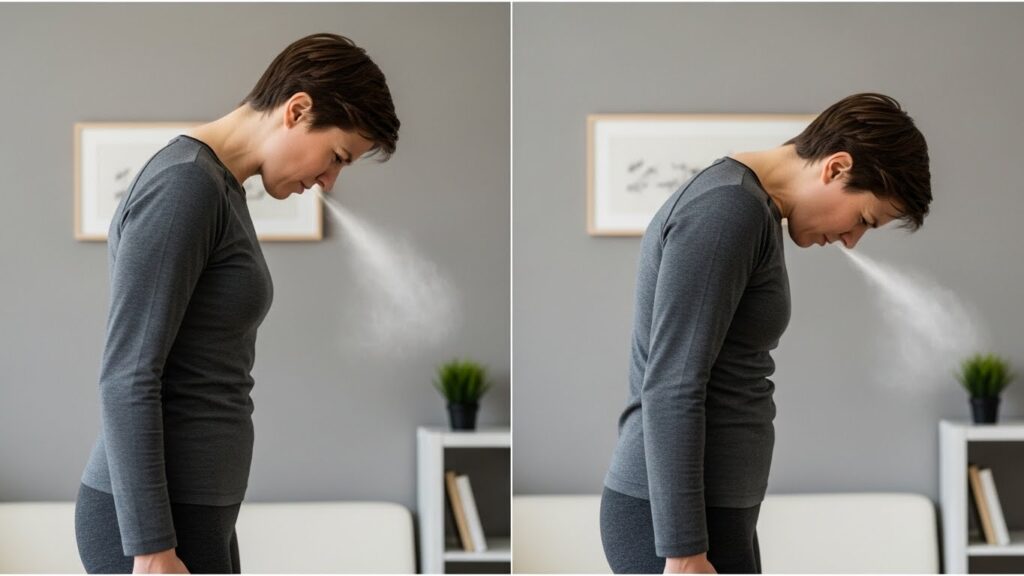
Coughing and sneezing create a rapid “internal shove” (intra-abdominal pressure). That’s normal. The problem is timing + posture: right after sleep, tissues tend to be stiffer, and many of us sneeze while leaning over a sink or pulling on socks. Pressure + stiffness + a rounded angle can equal a sudden “zap.”
The 0.1% fix: “Pre-load” your trunk before the sneeze lands—get tall, brace gently (20–30% effort), and use a hand support if you’re stuck in a forward position. You’re not fighting the sneeze. You’re giving the pressure a safer path.
🚩 Red flags: when this needs medical care
- New leg weakness, foot drop, or you’re suddenly tripping over your toes
- Bowel/bladder changes or groin numbness
- Fever, chills, night sweats, or feeling systemically unwell
- Major pain after a fall/accident, or severe pain that’s rapidly worsening
- Back pain plus chest pain, shortness of breath, or coughing up blood (urgent)
This page is educational and pattern-based. If you match red flags, don’t self-manage—get evaluated.
Last Updated: January 18, 2026 | Editorial Review: BodyEase Lab (mechanics + morning patterns) | Scope: YMYL-safe, non-medical education
I still remember the first time it happened. I rolled out of bed, leaned toward the sink, and sneezed—normal, harmless, nothing dramatic. Except my lower back fired a quick electric “catch,” like a trap door snapping shut. Two seconds later I was standing there, stiff and annoyed, thinking: “Did I just injure myself… from a sneeze?”
The good news: that jolt often isn’t your back “falling apart.” It’s a mechanics mismatch. A sneeze is a fast pressure event. A morning spine can be stiff. And if you’re bent forward, the load path is worse. Once you learn a tiny brace + posture habit, the “zap” usually becomes rare—or at least way less scary.
What’s actually happening during a sneeze
When you sneeze (or cough), your diaphragm and abdominal wall contract hard and fast. That creates a rapid rise in intra-abdominal pressure—basically a built-in stabilizer to protect your trunk during a forceful exhale. This is normal physiology.
The “morning zap” tends to show up when three things stack:
- Stiff baseline: after long stillness, tissues often feel less forgiving for the first few minutes.
- Reflex timing: your trunk’s automatic “brace” can be a beat late when you’re groggy or half-bent.
- Flexion multiplier: sneezing while rounded (sink, socks, phone) is the classic flare combo.
So the fix isn’t “avoid sneezing.” It’s pre-loading: get your trunk organized before the pressure hits. You’re trying to keep the spine closer to neutral and give the pressure a stable cylinder to push against.

Quick self-check: are you “jolt-prone”?
The morning sensitivity audit
- It’s worse before you’ve walked around or warmed up.
- It happens more when you’re bent forward (sink, socks, tying shoes).
- It improves quickly after heat or gentle movement.
- It feels like a quick jolt/catch, not a constant all-day ache.
If you checked 2–3, this is a great sign: you can often reduce it with mechanics and morning setup—not fear, not overthinking.
The 10-second “anti-zap” sneeze protocol
This isn’t medical treatment—just a safer habit. The idea is to brace before the sneeze lands and keep your spine out of a vulnerable rounded position.
Step 1: Get tall (2 seconds)
The moment you feel the tickle, pause. If you’re bent over, come up. If you’re seated, lift your chest gently. You’re aiming for “neutral-ish,” not military posture.
Step 2: “Zip-up” brace (3 seconds)
Lightly tighten your abdominal wall like you’re zipping snug jeans: 20–30% effort. Not a max squeeze. Not holding your breath. Just enough to make your trunk feel “solid.”
Step 3: Add hand support if you can’t get upright (5 seconds)
If you’re stuck at the sink or mid-sock, place one hand on the counter or your thigh. This “closed-loop” support helps redirect force away from the low back.
Pro tip: brace early, not perfectly
Most people brace as they sneeze—too late. The win is “pre-load.” Practice the gentle zip-up brace once or twice during the day so it becomes automatic in the morning.
The first 5 minutes after waking (so you’re less jolt-prone)
If your pain is mostly a morning event, you don’t just “fix the sneeze.” You lower the morning stiffness baseline so pressure spikes stop feeling like emergencies.
- 30 seconds: ankle pumps + 5 glute squeezes (still in bed).
- 60 seconds: slow breathing (long exhale) + tiny pelvic tilts (easy range).
- 60 seconds: stand and do 5 mini hip hinges (10–15% bend), hands lightly supported.
- 60–120 seconds: warmth cue (warm shower water or a warm towel on low back/hips).
- 30 seconds: practice one “zip-up” brace while standing tall (so it’s ready when you sneeze).
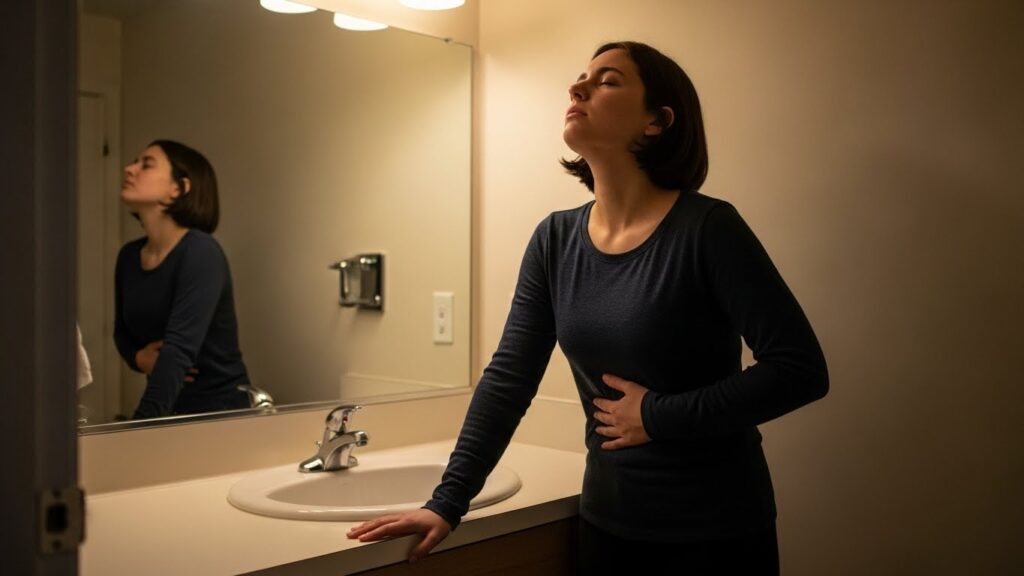
Trigger map: what your “jolt” is telling you
| Scenario | Likely driver | Fast, low-risk fix |
|---|---|---|
| Morning-only zap | Stiff baseline + slow “startup” timing | 5-minute reset + pre-brace habit |
| Zap while leaning over sink | Rounded spine angle under pressure | Get tall + counter support + zip-up brace |
| Zap radiates down the leg | Nerve irritation pattern (especially if persistent) | Don’t guess—consider medical evaluation |
| With fever / very unwell | Possible systemic issue | Seek urgent medical advice |
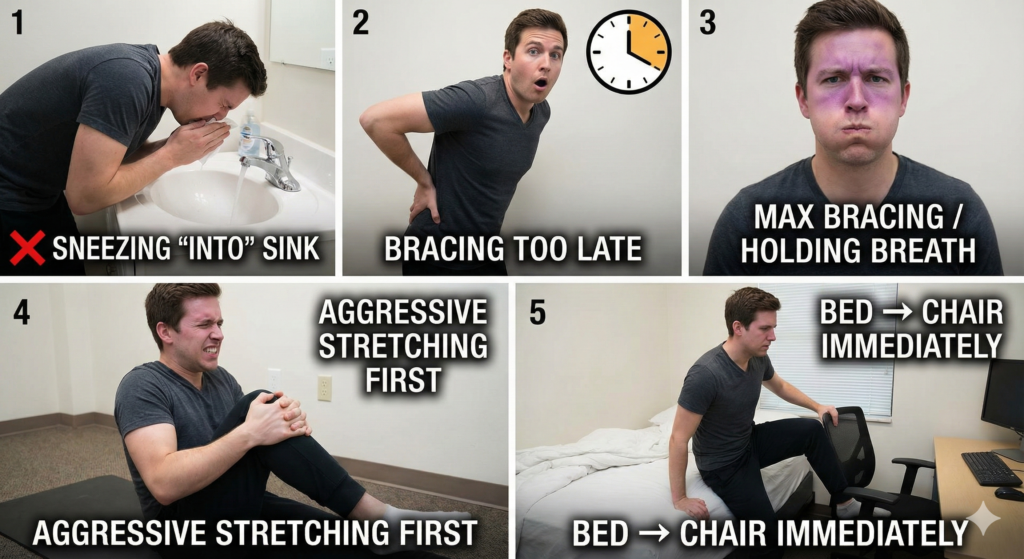
Common mistakes that keep the “morning jolt” alive
- Sneezing “into” the sink (rounded + pressure is the classic flare combo).
- Bracing too late (pre-load is the whole game).
- Max bracing or holding your breath (you want gentle stability, not a pressure contest).
- Aggressive stretching first thing instead of micro-moves + warmth + walking.
- Going bed → chair immediately when you already feel stiff (walking 2–5 minutes often changes the baseline).
The 7-day test (to confirm the pattern)
For one week: do the 5-minute reset every morning, and practice the 20–30% zip-up brace once or twice during the day. If the sneeze/cough jolt drops noticeably, you’ve basically proven this was mechanics + timing—not mystery damage.
FAQ
Does sneezing back pain mean a herniated disc?
Not automatically. A pressure spike can irritate stiff or sensitive tissues—especially first thing in the morning. If you also have persistent radiating leg pain, numbness, weakness, or worsening symptoms, get evaluated.
Why is it worse right after waking?
Many people feel stiffer after long stillness, and their “brace timing” is a little slower when groggy. Once you’re warm and moving, the same sneeze often feels less dramatic.
Should I try to suppress the sneeze?
Generally, no. Instead: stand tall, brace gently, and use hand support if needed. Suppressing can increase strain in weird ways.
What if it happens even when I’m standing upright?
Try the “pre-load” brace anyway, and watch patterns: morning-only vs all-day, stiffness vs nerve symptoms. If it’s frequent, escalating, or paired with red flags, get professional advice.
Can heat help?
For many people, yes. Warmth can make early movement feel smoother and reduce that “cold-start” vibe. Think comfort-level warmth, not intense heat.
Related BodyEase Lab posts
If your sneeze/cough jolt is part of a bigger morning pattern, these connect the dots:
Bending over in the morning hurts: why socks & sink bends feel brutal after sleep
Morning back pain routine: why I stopped rushing and fixed my stiffness
Heat helps morning back pain: why warmth works so fast after waking
Pillow under knees for back pain: a back-sleeper setup test
Stretching right after waking up: why it sometimes made morning pain worse
Sources & references
- Intra-abdominal pressures during coughing and sneezing (PMC)
- MedlinePlus (NIH): Back pain overview
- Mayo Clinic: Back pain — when to see a doctor
Professional disclaimer
This content is for educational purposes only and does not diagnose or treat medical conditions. If you have red flags (fever, significant swelling, new weakness/numbness, bowel/bladder changes, severe or worsening pain), seek professional care.
Update log
2026-01-18: Consolidated both drafts into a single “pressure + stiffness + posture” framework, strengthened the pre-load brace protocol, added a 5-minute morning baseline reset, and expanded trigger mapping.

Hi, I’m Chris
I’m not a doctor or a physio. I’m just a guy who spent 5 years battling crippling morning back pain while sitting at a desk job.
Traditional advice didn’t work for me, so I became obsessed with researching the science of recovery. This blog contains the practical, tested routines that finally helped me wake up pain-free.