
Ever wonder why your back acts up around 4 AM? It’s often less “mattress” and more “body clock + sensitivity.”
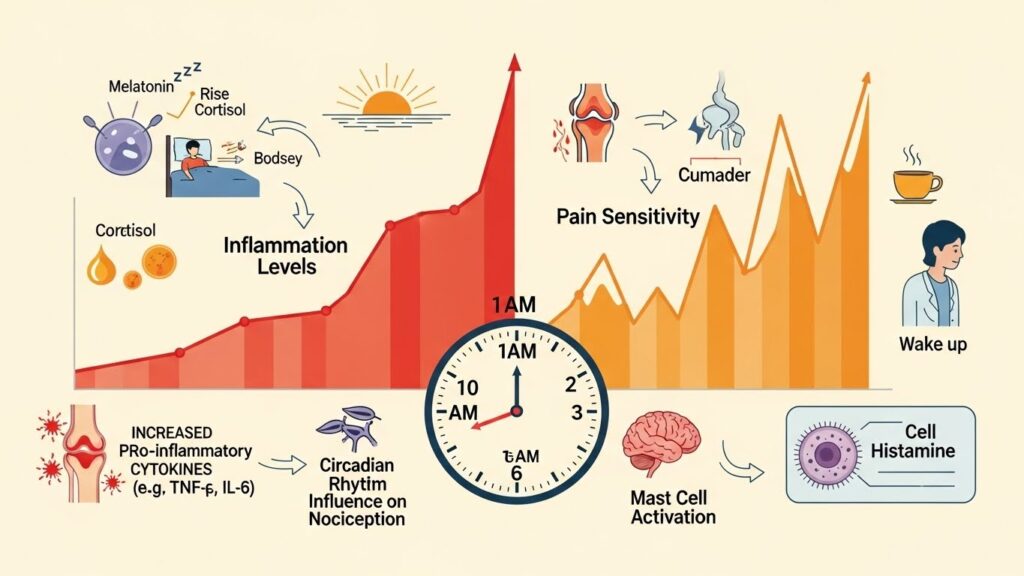
Many people notice a repeatable pattern: pain or stiffness feels louder in the late-night/early-morning window. One reason is circadian biology—your immune signaling, temperature, and pain sensitivity don’t stay flat all night. In some conditions, inflammatory messengers (including IL-6) show daily rhythms, and that can make tissues feel more “irritable” before dawn.
The Fix (safe default): Use a chronobiology-informed reset: tiny movement → gentle warmth → hydration. It’s not about “toughing it out.” It’s about lowering the sensitivity before you load your spine.
🚩 Stop! Check these Red Flags first
- Fever or chills alongside the pain (possible infection)
- Sudden weakness, major numbness, or trouble walking
- Loss of bladder/bowel control (emergency)
- Pain that keeps escalating at night and does not settle with gentle movement
- A history of cancer, or unexplained weight loss with new severe pain
This guide is for education only. If anything feels unusual or severe, get medical help.
The 4 AM Back Pain Mystery: Why Your Body’s Clock Can Amplify Inflammation
Last Updated: January 16, 2026 | By: BodyEase Lab Editorial Team | Status: Evidence-informed, non-diagnostic guide
You go to bed feeling okay… then somewhere in the early hours your lower back starts to throb or feel “wired.” It’s easy to blame the mattress or age. But when the timing is repeatable, the more useful question is: what changes in your body before sunrise?
The good news: for many people, this pattern is more about temporary sensitivity than sudden damage. If you can lower the sensitivity before you load your spine, mornings feel dramatically less dramatic.
The Science: Why sensitivity can peak while you sleep
Your brain runs on a timing system. The master clock (often described through the SCN) helps coordinate immune activity, temperature, and hormone rhythms. In some people—especially those with chronic stress, poor sleep, or existing inflammation—this timing can line up in an annoying way: tissues feel more reactive before dawn.
Two practical contributors matter most at 4-ish AM: (1) core temperature is near its nightly low (cooler tissue often feels stiffer), and (2) your pain sensitivity can rise as your body transitions toward waking. That doesn’t mean “damage is happening.” It means your system may be temporarily turned up.

Do You Fit the Profile?
Not everyone hits the peak at the exact same minute. Your chronotype (morning person vs. night owl), bedtime consistency, and even room temperature can shift the “worst window.”
The “Morning Stiffness” Test:
If your pain is noticeably higher on waking but drops after 30–60 minutes of normal movement, that pattern often fits circadian-driven sensitivity + stiffness more than a sudden structural injury.
The 6-Minute “Wake-Up” Protocol (do this before coffee)
The goal isn’t to “stretch hard.” In the early window, aggressive stretching can feel loud. Instead, think: downshift the alarm system, then gently reintroduce motion.
Phase 1: Calm the system (60s)
- Slow breathing: 4 seconds in, 6–8 seconds out, for 4–6 cycles. Keep it easy.
- Ankle pumps: 10–15 reps. It’s a gentle “circulation wake-up,” not exercise.
Phase 2: Gentle desensitization (120s)
- Pelvic tilts: Small range. Think “oil the gears,” not “train the core.”
- Knee sways: Side to side in a comfortable range. Smaller is usually better early.
Phase 3: Heat & hydration (120s)
- Targeted warmth: Warm shower or heat pack for 60–120 seconds. Comfort-level only.
- Water first: A glass of water before caffeine can help if you wake up “tight and dry.”
Personal tip that made a real difference for me: I stopped doing my first bend at the sink—my “rule” became no full forward bend until I’ve done 2 minutes of walking, even if it’s just pacing the hallway.
Which Type of Morning Pain Do You Have?
| Pain Pattern | The Likely Culprit | What to Do |
|---|---|---|
| Wakes you in early morning | Sensitivity window (circadian + temperature) | 6-min protocol + consistent bedtime |
| Pain when standing up | Load transition sensitivity | Slow rise; hinge from hips; avoid rushed bending |
| Gone in 5–10 minutes | Cold-start stiffness | Gentle bedside movements + warmth cue |
| Stiffness lasts > 1 hour | Possible inflammatory pattern | Medical evaluation (don’t self-diagnose) |
3 Mistakes Most People Make in the Morning
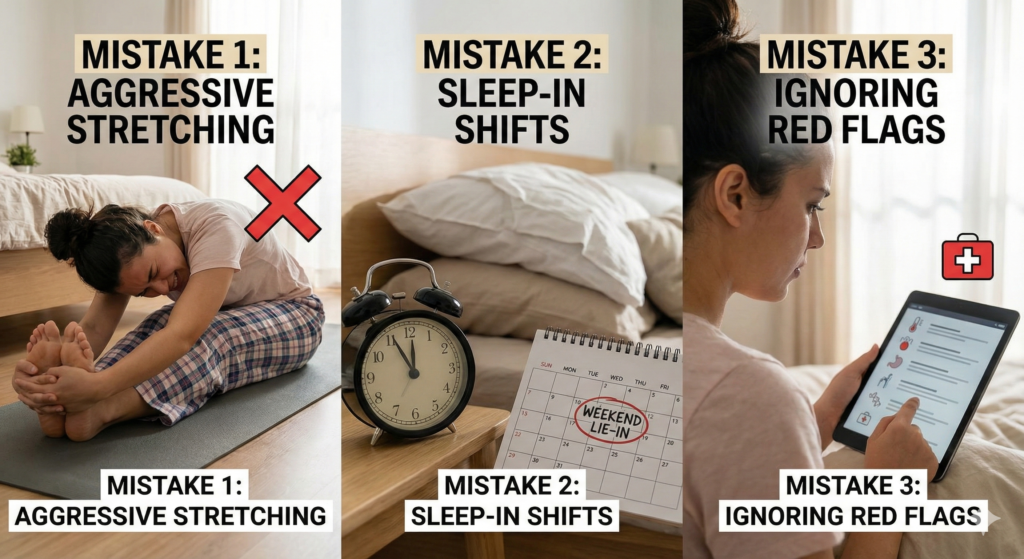
- Mistake 1: Going aggressive too early. When you’re sensitized, big-range stretching or deep forward bending can feel worse. Start small, earn range.
- Mistake 2: The “weekend lie-in” swing. Big shifts in wake time can mess with the timing window and make Monday feel brutal.
- Mistake 3: Ignoring red flags. Most morning pain is benign, but the serious stuff is serious—screen it first.
Common Questions
Is it normal for inflammation to vary by time of day?
Yes—many immune and pain-related signals show daily rhythms. The issue is when your symptoms repeatedly spike and disrupt sleep.
Will a new mattress fix early-morning pain?
A supportive setup can help, but timing-based sensitivity often responds faster to routine consistency (movement, warmth, sleep schedule).
Why does movement make it feel better?
Gentle motion warms tissue, increases circulation, and can reduce guarding—often lowering the “alarm volume” so pain feels less intense.
Deep Dives from BodyEase Lab
Full Bedside Mobility Routine
The “Sleeping In” Trap: Why more rest can hurt
Heat for morning stiffness: when it helps (and how to use it gently)
Scientific References
- The role of the circadian clock in arthritis (PMC)
- IL-6 rhythms and morning stiffness (PMC)
- Circadian patterns in pain sensitivity (preprint)
Disclaimer: This content is for informational purposes and does not replace professional medical advice. If you have red flags or persistent/worsening symptoms, seek clinical evaluation.
Last Reviewed: Jan 2026 by the BodyEase Lab editorial process (evidence-informed screening + readability check).

Hi, I’m Chris
I’m not a doctor or a physio. I’m just a guy who spent 5 years battling crippling morning back pain while sitting at a desk job.
Traditional advice didn’t work for me, so I became obsessed with researching the science of recovery. This blog contains the practical, tested routines that finally helped me wake up pain-free.