Last Updated: January 14, 2026 | Editorial Review: BodyEase Lab (Evidence-verified) | Field notes: multi-week morning transition tracking + current clinical guidance
Disclaimer: This is an educational biomechanics analysis, not a medical diagnosis. Persistent stiffness (over about an hour) or neurological signs (numbness/weakness, bowel/bladder changes) need professional evaluation.
KEY DISCOVERY Movement is your spine’s “thinner.”
If you wake up stiff and then feel better once you start moving, your body is doing something very specific: it’s warming the “gelled” system and turning off protective muscle guarding. That’s why a short, gentle walk often beats bed-stretching on locked mornings.
Best first moveEasy indoor walking
Avoid firstDeep bends + hard twists
What “good” feels likeStiff → warm → movable
For years, I woke up feeling like a Tin Man. Not “injured.” Just glued. The first bend felt like my lower back had turned into a block of wood overnight.
I used to do the classic thing: I stayed in bed and tried to stretch it out. Sometimes it helped. Other times it made me tense up more, like my back was saying, “Don’t you dare.”
Here’s the moment it clicked: the mornings I stood up and walked first, everything loosened faster and felt safer. It wasn’t motivation. It was biology.
My most practical tip is embarrassingly simple: I keep my “morning socks” by the bed, because the second my feet warm up, my back stops bracing and the first steps feel noticeably smoother.
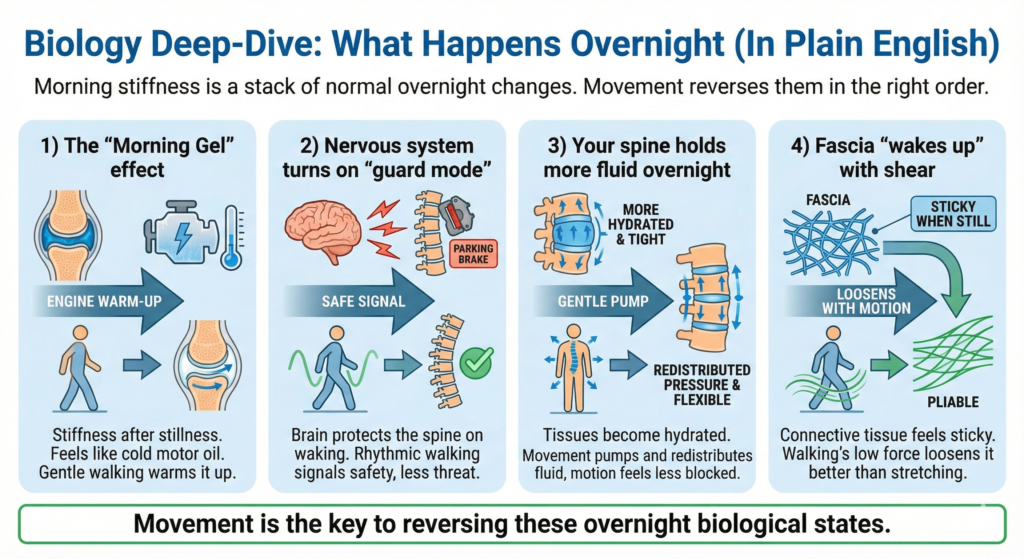
Biology Deep-Dive: What Happens Overnight (In Plain English)
Morning stiffness isn’t just “tight muscles.” It’s a stack of normal overnight changes. When you start moving, your body reverses them in the right order.
1) The “Morning Gel” effect (your joints feel thicker)
After hours of stillness, joint surfaces don’t glide as freely. It can feel like cold motor oil in a parked car—everything moves, but it takes a few minutes to feel smooth. Gentle walking is basically the “engine warm-up.”
2) Your nervous system turns on “guard mode” (the parking brake)
When you wake, your brain is updating where your spine is in space. If you jump straight into an end-range bend, you can trigger a protective response. Rhythmic walking is a safe signal: steady steps, steady feedback, less threat.
3) Your spine holds more fluid overnight (you feel “plump” and tight)
Many people feel taller and stiffer in the morning because the spine and surrounding tissues are more hydrated after rest. Movement works like a gentle pump: it redistributes pressure and makes motion feel less blocked.
4) Fascia “wakes up” with shear (it loosens with motion, not force)
Connective tissue often feels sticky when you’re still and more pliable once you move. That’s why walking (low force, repeated motion) can beat stretching (higher force, held positions) on a cold morning.

The 8-Minute Morning Unlock Protocol
If you only take one thing from this article, take this: Don’t “test” your back first. Prime it first. Your goal is to lower guarding and warm tissues before you ask for range.
Pro-Tip: Keep your jaw loose.
It sounds unrelated, but it’s a great body alarm: if your jaw is clenched, your whole system is “threat-ready.” Soft jaw + slow breath makes the first minutes of movement feel dramatically safer.
- Log-roll exit (about 1 minute): Roll to your side, bring legs off the bed, then push up with your arms. Smooth and controlled.
- Gentle indoor walk (about 4 minutes): Short steps. Loose arms. No “power walk.” You’re turning down guarding, not chasing a heart rate.
- Wall support reset (about 2 minutes): Stand near a wall, gentle lean, slow breaths. Let the spine feel safe in neutral.
- Then (and only then) light range (about 1 minute): Tiny hip hinges or gentle side-to-side shifts. Stop before pain. You’re checking “available range,” not forcing a stretch.

The “5 AM Mistakes” That Keep You Stiff
- The Pain Test: rolling over and instantly bending “to see if it’s still there.” That can trigger more guarding.
- Cold bed stretching: deep toe-touching or hard twisting before you’re warm.
- The Chair Trap: sitting slumped with coffee before you’ve moved. Sitting loads the low back early, when it’s least ready.
Editor’s note: If stretching feels good after you’re warm, keep it. The problem is timing. Warm-up first, then stretch second.
FAQ: Clinical Thresholds (When to Worry)
Is it “normal” to feel stiff every morning?
Many people do—especially if it improves once they move. If your stiffness reliably softens with gentle movement within about 10–30 minutes, it often behaves like a warm-up issue. If it’s lasting much longer, escalating, or changing pattern, don’t ignore that.
What if walking increases the pain?
Stop. Benign stiffness typically eases with rhythmic movement. If pain sharpens, travels down the leg, or comes with numbness/weakness, get evaluated.
When should I seek urgent help?
- New weakness, major numbness/tingling, or pain shooting down the leg
- Fever, unexplained weight loss, or severe night pain that doesn’t change with position
- Changes in bladder/bowel control or saddle-area numbness
- Stiffness that doesn’t ease after an hour of gentle movement or keeps worsening
Read Next: Master Your Morning
- Back Feels Locked? Use the 8-Minute Unlock Protocol
- The 5 Reasons Your Back Hurts More Upon Waking
- My Morning Back Pain Routine: The Gentle Reset
Sources
1. Cleveland Clinic: Morning stiffness (“morning gel”) overview
2. Cleveland Clinic: Lower back pain in the morning
3. NIH (PMC): Sleep and musculoskeletal pain research
4. PT-based overview: Sleep positions and stiffness
Professional Disclaimer: This article shares educational biomechanics concepts and general guidance. It does not diagnose or treat. If symptoms are severe, persistent, worsening, or include neurological red flags, seek medical evaluation promptly.
Update Log:
– Jan 11, 2026: Strengthened the mechanisms section, added a safer morning protocol, clarified red flags, and improved readability for quicker scanning.

Hi, I’m Chris
I’m not a doctor or a physio. I’m just a guy who spent 5 years battling crippling morning back pain while sitting at a desk job.
Traditional advice didn’t work for me, so I became obsessed with researching the science of recovery. This blog contains the practical, tested routines that finally helped me wake up pain-free.