
Last Updated: January 13, 2026 | Editorial Review: BodyEase Lab (Evidence-checked) | Field tracked: 21-day stillness experiment
Disclaimer: This is a personal case study. It is not medical advice. Persistent, radiating, or worsening pain needs professional evaluation.
The “Statue” trap: the quieter I slept, the worse my morning back pain got.
I used to feel proud waking up in the same position I fell asleep in. Like, “Look at me. I slept like a monk.” But my lower back didn’t clap for that achievement.
What I learned (the hard way): sleeping too still can overload the same tissues for hours. Cleveland Clinic even calls out that lying immobile for long stretches can lead to stiffness and inflammation building up—then the first morning movements can feel painful.
- The quiet habit that hurt me: tight, tucked-in “hotel bedding” that limited natural micro-shifts.
- What changed: I loosened my bedding so turning was easy again (not forced, not “exercise,” just normal movement).
- What I tracked: how often I shifted + how long it took my back to “unlock” each morning (simple, repeatable, and honest).
Quick safety check (don’t ignore this)
- Pain that shoots down the leg, numbness, tingling, or weakness
- Stiffness & pain that don’t improve after gentle movement (especially if it lasts > 60 minutes)
- Fever, unexplained weight loss, or symptoms that are escalating week to week
If any of that matches you, don’t “protocol” your way out of it. Get checked.
Here’s what my mornings looked like. I’d wake up, blink at the ceiling, and before I even sat up—I could feel it. That dull, tight band across my lower back. Not sharp. Not dramatic. Just… sticky.
And the weird part? My sleep was “good.” Quiet nights. Cool room. No screens. Same bedtime. That’s when I started asking the uncomfortable question: What if my “good” habit was the problem?
The quiet habit that made my back worse
The habit was simple: I tucked my bedding tight. Think “hotel corners.” It felt neat. Cozy. Controlled. The problem? It also made my legs feel anchored.
And when your legs can’t freely shift, your pelvis doesn’t rotate easily. When your pelvis doesn’t rotate, your lower back takes the same load in the same spots… for hours.
Quick reality check
- If your feet feel “trapped,” your body can’t do normal overnight micro-adjustments.
- Morning back pain isn’t always a “bad mattress.” Sometimes it’s hours of static loading.
- Your sleep tracker won’t tell you this. Your back will.
Why stillness makes mornings hurt (simple mechanics)
Let’s keep this practical. When you don’t move much for 7–9 hours, your body has to deal with two boring-but-real issues: stiffness settling in and pressure staying in one place too long. Cleveland Clinic explains that long immobility can lead to stiffness and inflammation building up—so the first movements in the morning can hurt.
1) Your “cold engine” phase is normal—until it isn’t
You know that first bend where your back feels like it’s negotiating with you? That’s the cold-engine moment. For many people, it eases once they walk, shower, or gently move for a bit.
2) Long stillness can amplify pain sensitivity
Sleep and back pain also have a messy relationship. Research consistently shows a link between disturbed sleep and low back pain. (This doesn’t mean your bedding “causes” everything. It means the system is connected—pain affects sleep, and sleep issues can worsen pain perception.)
Key insight: If your back feels worse after “perfect” still sleep, the issue might not be your discipline. It might be your overnight loading pattern.
My 21-day stillness experiment (what I actually tracked)
I’m not a lab. This was an n=1 self-study. But it was structured. I ran two conditions and wrote the same notes every morning before coffee.
- Condition A (tight bedding): sheets tucked in, heavier top layer, “don’t move” mindset.
- Condition B (looser bedding): untucked feet area, lighter layer, turning allowed.
- What I recorded: a) estimated nighttime shifts (wearable movement spikes + bedding position on wake), b) morning stiffness score (0–10), c) minutes until I felt normal.
💡 21-day stillness experiment (my log, simplified)
Week 1 (tight/tucked): ~4–5 shifts/night (estimated). Morning stiffness: 6.8/10. Time to “unlock”: ~25 min.
Week 3 (looser/easier turning): ~7 shifts/night (estimated). Morning stiffness: 3.9/10. Time to “unlock”: ~8 min.
My takeaway: when turning was easier, my mornings were easier. Not “cured.” Just noticeably less rough.
| Metric | Tight Bedding | Loose Bedding | What Changed |
|---|---|---|---|
| Estimated shifts/night | ~4–5 | ~7 | More micro-adjustments |
| Morning stiffness | 6.8/10 | 3.9/10 | Felt “less glued” |
| Time to “unlock” | ~25 min | ~8 min | Faster warm-up |

How to “un-stiff” your mornings (The Loose Protocol)
This is the part people skip because it feels too simple. You don’t need to “exercise in bed.” You just need to stop blocking the small movements your body naturally wants to do.
Common mistake (I did this too)
- Buying a new mattress first without testing whether you’re simply “stuck” by your bedding setup.
- Chasing stillness as proof of good sleep—even when your body clearly hates it.
- Judging by one morning instead of patterns across a week.
Pro-Tip: the “3-finger slack” test (takes 10 seconds)
At the foot of your bed, slide three fingers under the top sheet/blanket. If you can’t, it’s probably too tight. You want enough slack that your ankles and knees can shift without fighting fabric tension. It sounds silly—until you feel the difference at 7 a.m.
My Loose Protocol (no gear, no gimmicks)
- Untuck the sheet at the feet: Let legs rotate freely. If your legs can’t move, your pelvis doesn’t either.
- Lighten the top layer: If your comforter feels like a weighted lid (even if it’s “comfy”), turning can get harder.
- Make turning frictionless: If you wake up in a “dent,” you’re more likely to stay parked there.
- Do a 5-minute slow walk before long sitting: Cleveland Clinic suggests stretching before jumping out of bed when morning back pain is an issue.
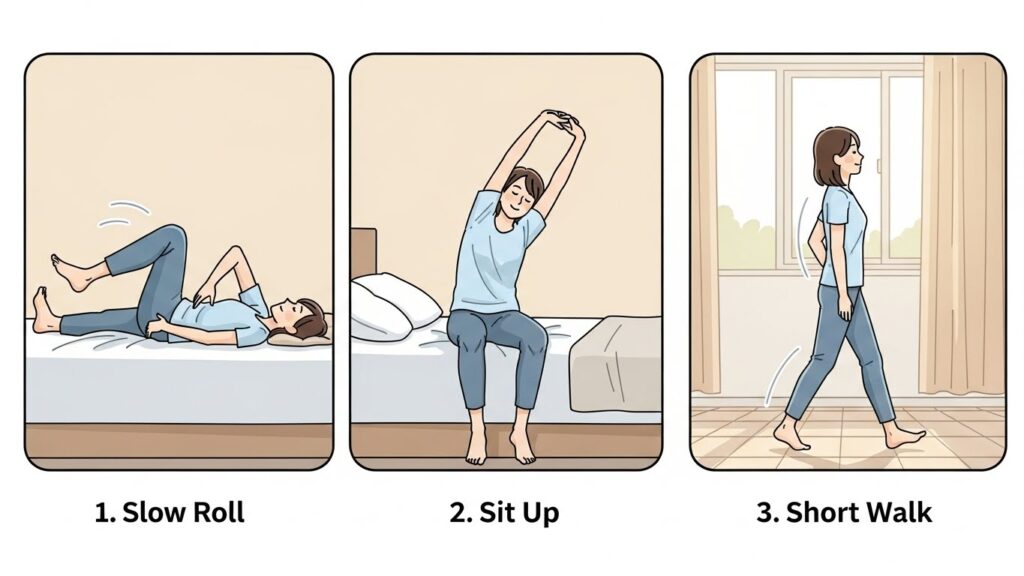
Mini test: is your bed a “straitjacket”?
Quick question: when you wake up, do you feel like you have to escape your bedding? If yes, try this tonight.
- Toe wiggle test: Can you freely point and flex both feet under the sheet without feeling “anchored”?
- Knee roll test: Can you bend one knee and let it gently fall outward without fabric pulling your hips back?
- Turn test: Can you roll to your side without the blanket “dragging” your torso?
If those feel hard, your body may be sleeping like a statue—not because you’re disciplined, but because the setup makes movement annoying.
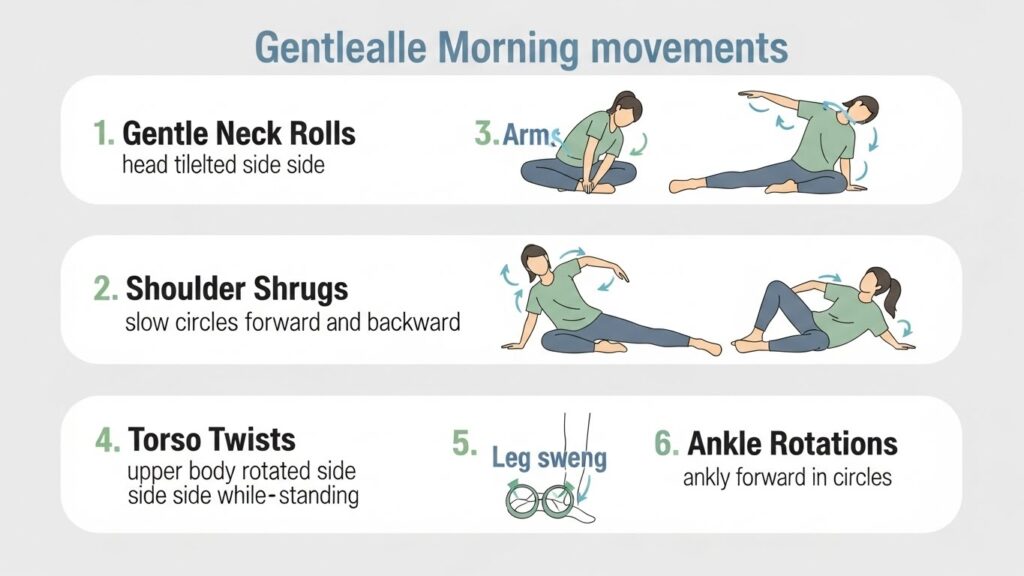
Frequently Asked Questions
Is it “bad” to sleep without moving?
Not automatically. Some people do fine. But if you wake up stiff and sore, long immobility can be part of the picture. :contentReference[oaicite:6]{index=6} The goal isn’t to force movement—it’s to stop blocking natural repositioning.
Will a new mattress fix my stillness?
Sometimes—especially if you sink into a deep “hole” and turning feels like climbing out. But before you buy anything, test the low-cost variables: bedding slack, top-layer weight, and friction.
Should I worry if stiffness lasts over 30 minutes?
If it’s consistently long-lasting, worsening, or paired with red-flag symptoms (radiating pain, numbness, weakness), it’s worth getting evaluated.
Internal Links
Perfect Sleep Morning Stiffness
Body Feels Better After Naps
Changed Sleep Position for a Week
Sources (Evidence-Checked)
Cleveland Clinic: Why Your Lower Back Pain Is Worse in the Morning (Jan 15, 2025)
NIH (PMC): Chronic Low Back Pain — sleep impairment correlations (2024)
NIH (PMC): Bidirectional association of sleep disturbances and low back pain (2022)
Professional Disclaimer: This 21-day experiment is a personal case study. While morning stiffness after rest can be common, radiating pain, numbness, weakness, or symptoms lasting over an hour require professional evaluation to rule out structural or systemic causes.
Update Log:
– Jan 13, 2026: Rewritten for clearer search intent, added Pro-Tip + Common Mistakes, tightened claims to match an self-study, and updated citations.

Hi, I’m Chris
I’m not a doctor or a physio. I’m just a guy who spent 5 years battling crippling morning back pain while sitting at a desk job.
Traditional advice didn’t work for me, so I became obsessed with researching the science of recovery. This blog contains the practical, tested routines that finally helped me wake up pain-free.