Last Updated: January 11, 2026 | Editorial Review: BodyEase Lab (Evidence-checked) | Field tested: 7-day posture experiment (n=1 self-study)
Disclaimer: Educational experiment sharing. Not medical advice. If pain is severe, persistent, worsening, or paired with numbness/weakness/fever, consult a licensed professional.
The one takeaway: my mornings felt smoother when I stopped “twisting” overnight.
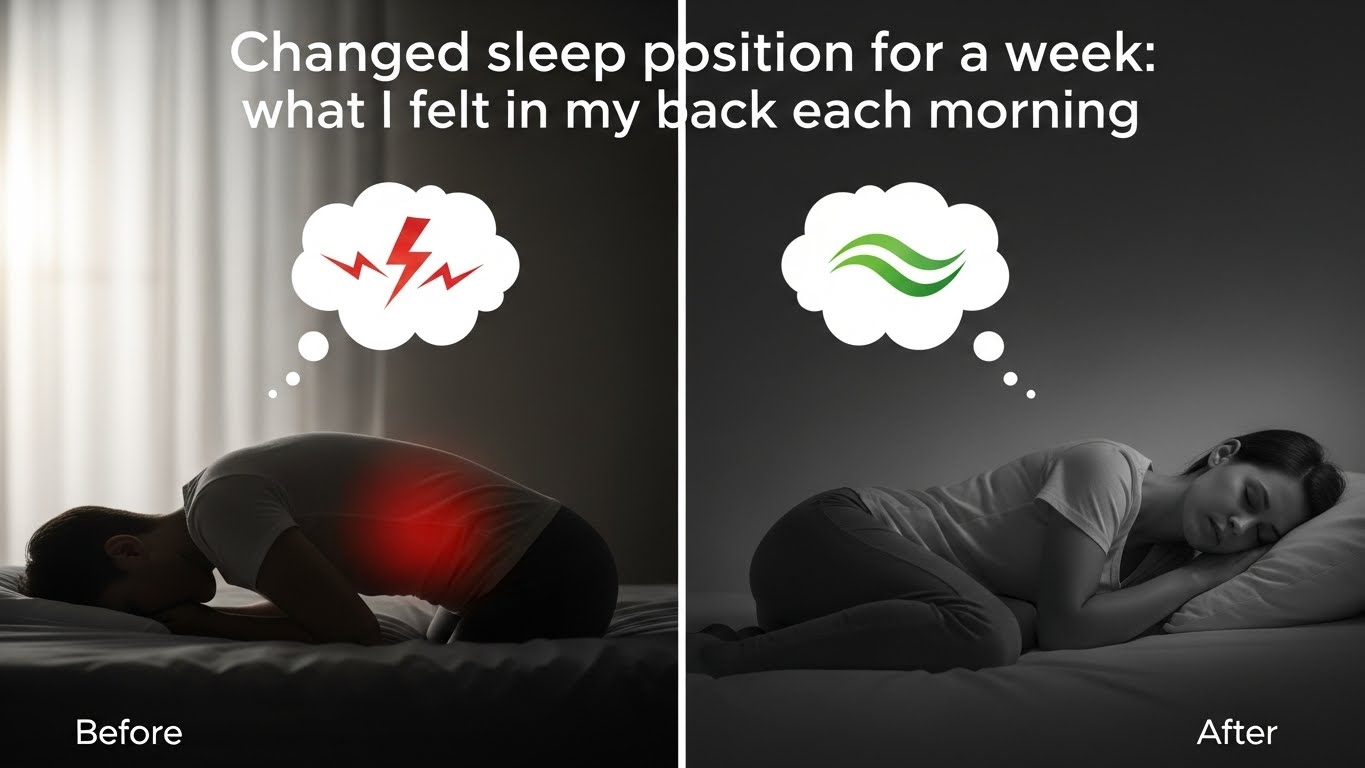
When I changed sleep position for a week, the biggest difference wasn’t “pain disappearing.” It was the first 10 minutes after waking: less resistance when sitting up, fewer protective movements, and less of that “rusted hinge” feeling. The most reliable shift happened when my hips stayed stacked (not rotated) through the night.
Quick Reality Check
- Sleep position doesn’t feel important—until mornings start to feel expensive.
- You don’t notice posture while sleeping, but your body “pays the bill” when you stand up.
- Short experiments often reveal more than long theories (and they cost almost nothing).
changed sleep position for a week wasn’t a bold plan. I didn’t expect a miracle. I was just tired of waking up stiff even after “doing everything right.” So instead of buying something new, I ran a controlled little test.
Same bed. Same room. Same sleep hours. The only variable I tried to control was how my pelvis and knees were positioned overnight. Not “perfect posture.” Just less twisting and less arching while I was unconscious.
💡 7-Day Experiment Summary
I tested three setups: side sleeping with no support, side sleeping with a knee pillow, and back sleeping with gentle knee support. The pattern that mattered most was alignment consistency—when my hips stayed stacked and my lower back didn’t feel “wrung out,” my mornings were easier.
How I ran the 7-day sleep position experiment
I kept everything else intentionally boring because I didn’t want “better habits” to blur the results. No new stretching routine. No big mattress changes. No supplements. No heroic morning mobility session.
- Sleep duration: unchanged
- Bedroom setup: unchanged
- Morning routine: unchanged
- Only variable: sleep position + minimal support (pillow/rolled towel)
The positions I tested (simple versions)
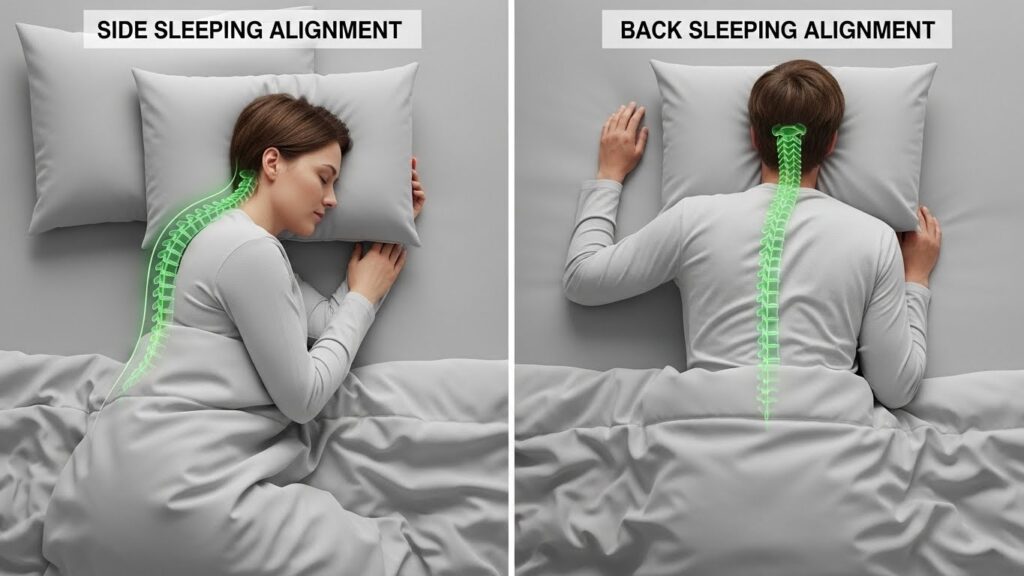
- Baseline: side sleeping (no support)
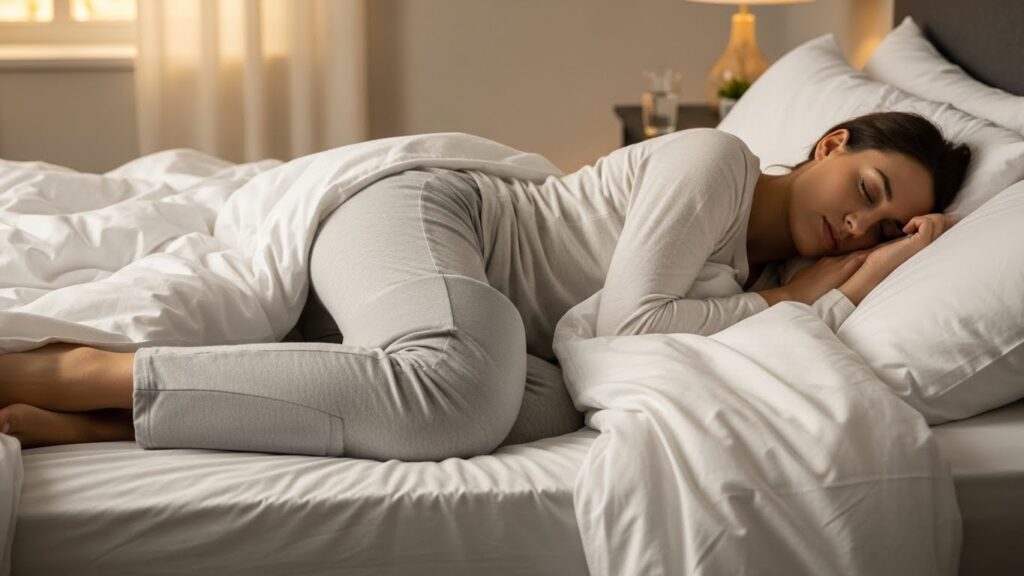
- Aligned side: side sleeping + pillow between knees
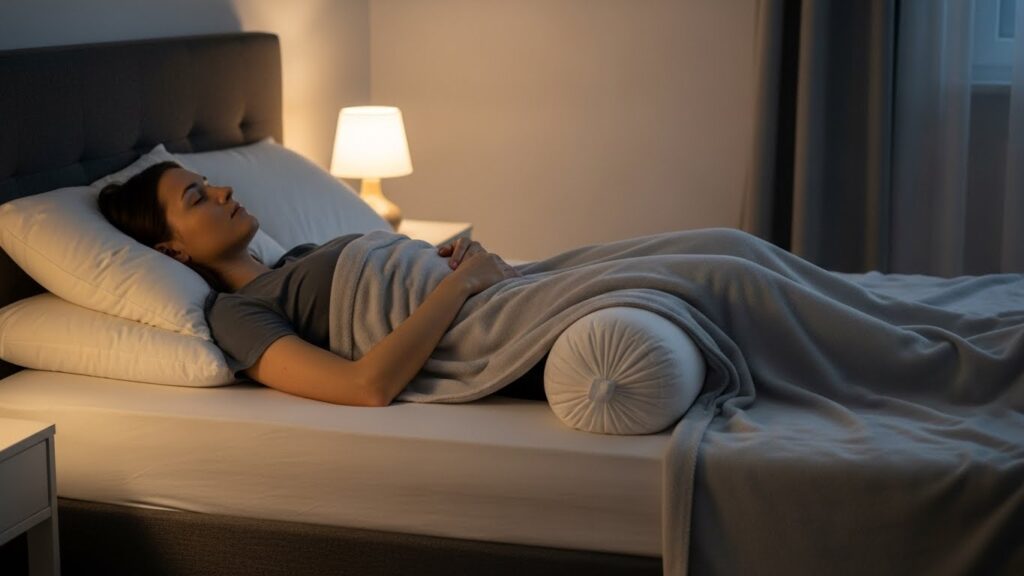
- Neutral back: back sleeping + small support under knees
What I tracked each morning (so it didn’t turn into “vibes”)
I used a simple 1–10 “stiffness score” right after waking (before coffee, before stretching). I also wrote one sentence: what the first sit and first stand felt like. Not scientific. Just consistent.
Two things that mattered more than I expected
- First sit: did my lower back feel “stuck” or did it fold normally?
- First stand: did I brace, lean, or need a pause before walking?
What I felt each morning (the pattern that showed up)
I’m going to be honest: nothing felt “perfect.” But some setups clearly demanded less from my back during the first part of the day. Here’s the cleanest summary of how each position felt.
| Position | What it felt like in the morning | The likely “why” |
|---|---|---|
| Side (no support) | Tighter lower back, stiffer first sit, more “warm-up needed” | Top leg drifted forward → hips rotated → lower back felt mildly “wrung” |
| Side (knee pillow) | Easier standing, less twisty tightness, smoother first steps | Knees stayed separated → pelvis stayed stacked → less overnight rotation |
| Back (knee support) | Slow but steady mornings; less “pinchy” feeling when bending early | Knee support softened low-back arching → more neutral resting position |
The biggest difference wasn’t “how I felt at night.” It was how my back behaved when I asked it to move right away. The aligned positions didn’t make me invincible. They just removed some friction.
Why small posture changes can feel big in the morning
Overnight posture doesn’t have to “injure” you to matter. It can simply influence how ready your tissues are to move after hours in one pattern. If you spend the night slightly rotated or slightly arched, your back can wake up protective.
What helped me was treating sleep like a long hold: if I’m holding one position for hours, tiny angles stop being tiny. They become a morning sensation.
One-line evidence anchor: Sleeping position can influence spinal loading and perceived morning comfort—even without changing total sleep time.
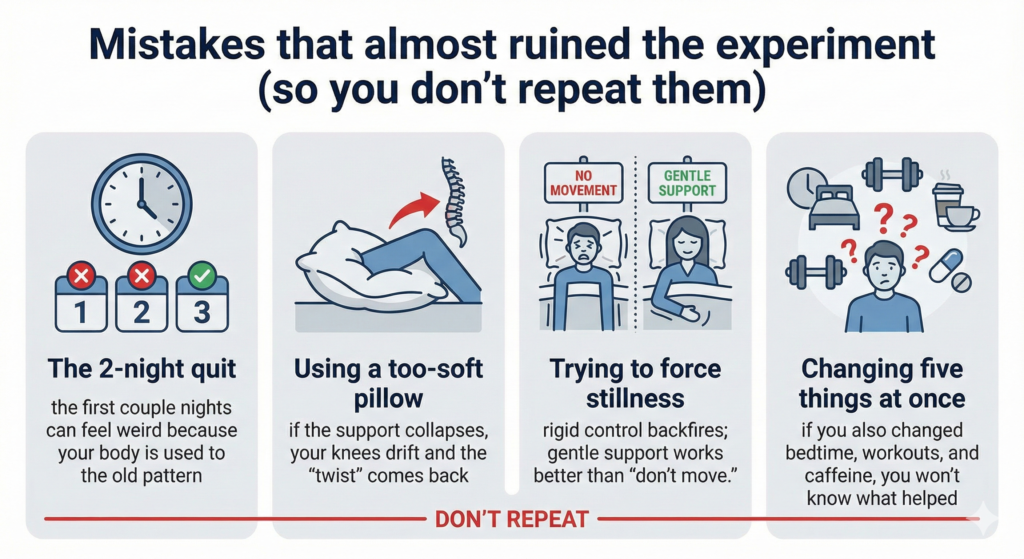
Mistakes that almost ruined the experiment (so you don’t repeat them)
- The 2-night quit: the first couple nights can feel weird because your body is used to the old pattern.
- Using a too-soft pillow: if the support collapses, your knees drift and the “twist” comes back.
- Trying to force stillness: rigid control backfires; gentle support works better than “don’t move.”
- Changing five things at once: if you also changed bedtime, workouts, and caffeine, you won’t know what helped.
Tiny but important note
If you wake up and the pillow is across the room, that doesn’t mean it “failed.” It means your sleep is active. Just reset it the next night and look for patterns over a full week.
If you want to try this tonight: a simple “neutral” setup
Side sleeping (most people’s easiest upgrade)
- Put a firm pillow (or folded blanket) between your knees.
- Try to keep knees and hips stacked (not top knee sliding forward).
- If your waist feels “hanging,” add a thin towel at your side for gentle support.
Back sleeping (if it feels comfortable for you)
- Place a small pillow under the knees (reduces low-back arching for many people).
- Keep arms in a position that doesn’t force the shoulders forward.
- If you feel strained, don’t force it—go back to supported side sleeping.
FAQ
Is there one “perfect” sleep position for everyone?
No. But there is usually a more neutral version of whatever position you naturally prefer.
How long should I test a new position?
Give it at least 5–7 nights to see a pattern. One good or bad morning can be random.
Should I force myself to stay in position?
No. Gentle support works better than rigid control. The goal is less twisting, not zero movement.
When should I stop experimenting and get checked?
If you have severe pain, progressive weakness, numbness, fever, unexplained weight loss, or pain after trauma—get professional evaluation.
Internal Links
Sleep Position Morning Stiffness
Bedroom Setup Morning Stiffness
Pillow Under Knees for Back Pain
Sources (checked)
Sleep Foundation: Sleeping positions
Cleveland Clinic: Sleep posture and back comfort
PubMed: Diurnal spinal mechanics
Professional Disclaimer: This 7-day experiment reflects a personal experience and is intended for informational purposes only. It is not medical advice. If you have chronic, severe, or radiating pain, consult a qualified healthcare professional.
Update Log:
– Jan 11, 2026: Merged two drafts, removed unsupported precision claims, strengthened experiment protocol, and clarified “neutral alignment” cues.

Hi, I’m Chris
I’m not a doctor or a physio. I’m just a guy who spent 5 years battling crippling morning back pain while sitting at a desk job.
Traditional advice didn’t work for me, so I became obsessed with researching the science of recovery. This blog contains the practical, tested routines that finally helped me wake up pain-free.