
Last Updated: December 29, 2025 | Editorial Review: WorkNest Studio (Evidence-checked) | Note: Informational only (not medical advice)
Disclaimer: This article shares general education and personal-style observations. It does not diagnose, treat, or replace professional medical care. If symptoms are severe, persistent, or paired with neurological changes, consider medical evaluation.
Quick Standard (keep mornings boring)
- If mornings are your “sensitive window,” avoid instant sitting + instant bending.
- First goal: warm tissues and reduce sudden loading for 5–10 minutes.
- Think gradual transition before your first real “life bend” (socks, sink, laundry) and delay your first prolonged sit if possible.
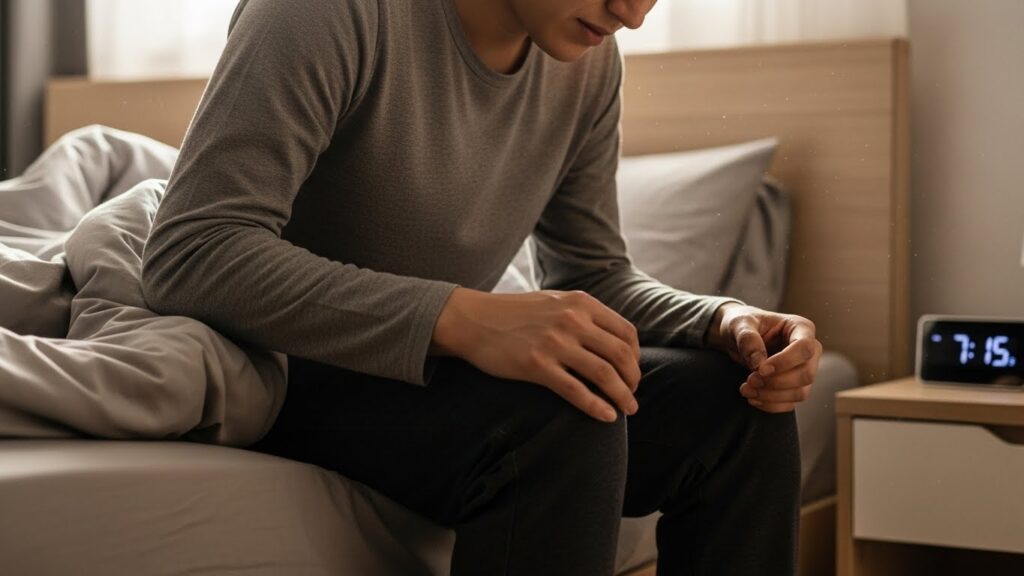
sitting right after waking up used to feel harmless. I’d roll out of bed, sit down, check my phone, then lean forward to put on socks. And weirdly… that was often the moment my back got cranky. I wasn’t lifting weights. I was just sitting. Once I noticed the pattern, I stopped doing it the same way—and mornings got easier.
💡 Quick Summary
Sitting right after waking up can feel worse because your body goes from hours of stillness to immediate spinal loading, often followed by forward bending. A safer morning move is usually a short transition: a slow log-roll, 60 seconds upright breathing, 2–3 minutes of easy walking, then gentle mobility—before any deep bend.
⚠️ Red flags (don’t “routine” your way through these)
- New bladder/bowel control changes
- New numbness around the groin/saddle area
- Rapidly worsening leg weakness or severe radiating symptoms
If you’re unsure—or symptoms are new, severe, or worsening—treat it as urgent and get medical help.
Why sitting right after waking up can feel like a trigger
Here’s what I think happens in real-life mornings: you wake up stiff, you sit, then you do a “mini crunch” forward to reach something. That combo—stillness → load → bend—is a classic way to irritate a sensitive back.
1) The spine is more time-sensitive in the morning
Research on diurnal changes in spinal mechanics suggests spinal structures carry different loads at different times of day, and symptoms can be time-linked for a reason. That doesn’t mean something is “broken”—it means timing matters.
One-line evidence anchor: Studies on diurnal spinal mechanics discuss how disc water content and spinal loading change across the day, which may help explain why some symptoms peak in the morning.
2) Sitting often leads to the first deep bend
Sitting itself isn’t “bad.” The problem is what sitting tends to cause: slumped posture, then a forward reach. If your first meaningful bend happens before you’ve warmed up, it can feel sharper than it “should.”
3) Cold + still tissues behave differently
If your room is cool or you slept very still, tissues may feel less elastic. That’s one reason heat (shower, warm room) can feel helpful for some people.
What I do instead: a 6-minute “no-drama” protocol
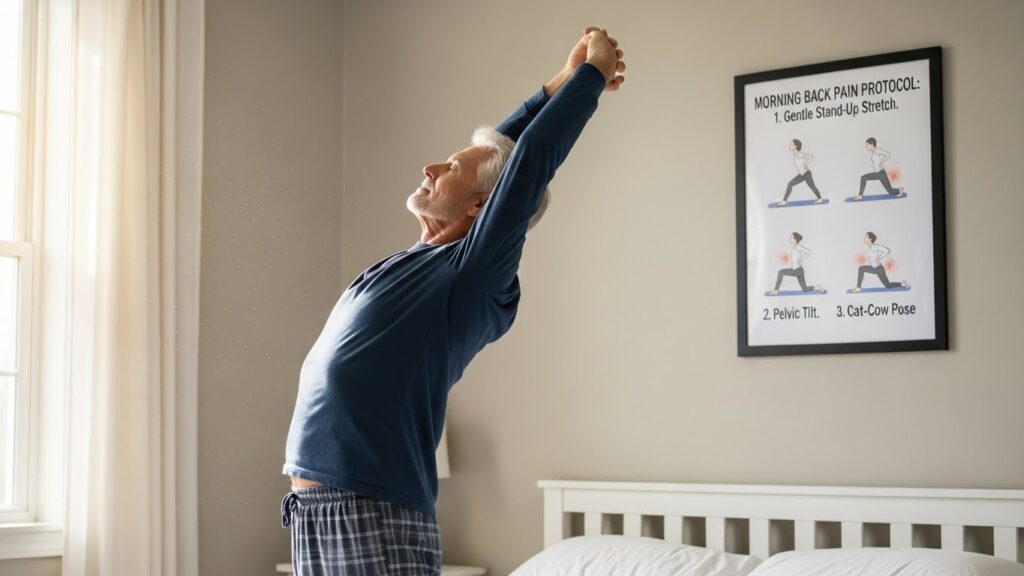
I’m not trying to become a morning athlete. I’m trying to reduce shock. This is the sequence that felt realistic and repeatable.
| Time | What to do | Why it helps |
|---|---|---|
| 0–60 sec | Log-roll + slow sit | Avoids sudden twisting and rushed flexion |
| 1–2 min | Edge-sit breathing (upright, relaxed ribs) | Gentle transition before full loading |
| 2–5 min | Easy walking (slow loop) | Warms tissues + reduces stiffness perception |
| 5–6 min | Micro pelvic tilts (small, pain-free) | Mobility without forcing a deep stretch |
Two environmental tweaks that helped
- Warm the room slightly: cooler temps can make stiffness feel louder.
- Move socks/shoes higher: reduce the “first bend” depth until you’ve walked a bit.

FAQ
Is sitting right after waking up always bad?
Not always. For many people it’s fine. But if you’re in a morning “sensitive window,” sitting often leads to slumping and early forward bending.
Should I stretch first thing?
Many people tolerate gentle movement better than deep stretching right away. A short walk can be a safer first step.
When should I worry?
If you have red-flag symptoms (bladder/bowel changes, saddle numbness, rapidly worsening weakness), treat it as urgent.
Internal Links
https://bodyeaselab.com/morning-back-pain-routine/
https://bodyeaselab.com/stiff-back-in-the-morning/
Sources (checked)
- PubMed: Diurnal changes in spinal mechanics and their clinical significance
- Cleveland Clinic: Why back pain can be worse in the morning
- Sleep Foundation: Lower back pain after sleeping (causes & tips)
- NHS: Cauda Equina Syndrome (warning signs)
Professional Disclaimer: This content is for education and general guidance only. It does not provide medical diagnosis or individualized treatment. If pain persists, worsens, or interferes with daily activities, consider consulting a licensed healthcare professional.
Update Log:
– Dec 29, 2025: Added protocol table + refined trigger explanation + verified external sources.

Hi, I’m Chris
I’m not a doctor or a physio. I’m just a guy who spent 5 years battling crippling morning back pain while sitting at a desk job.
Traditional advice didn’t work for me, so I became obsessed with researching the science of recovery. This blog contains the practical, tested routines that finally helped me wake up pain-free.